

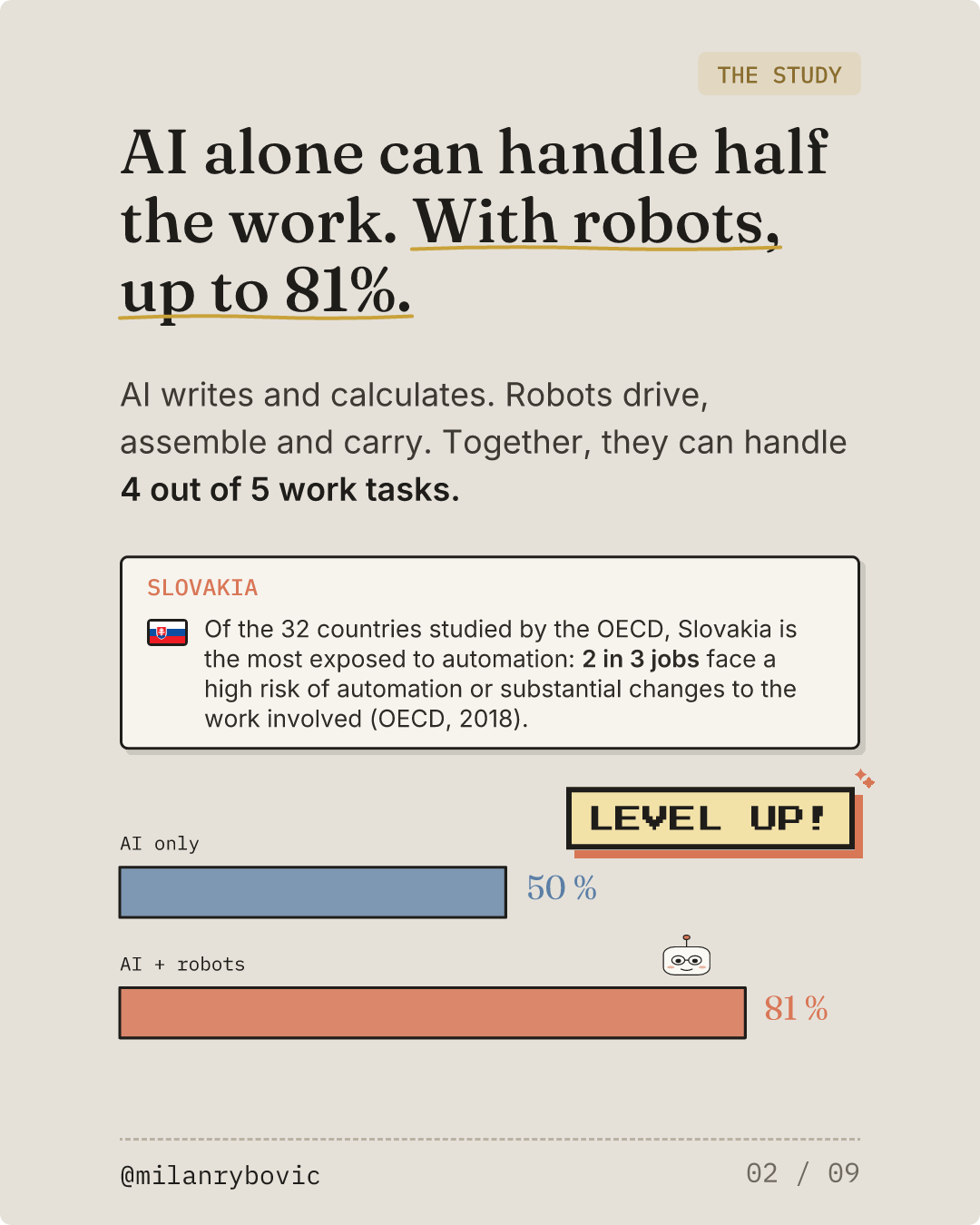
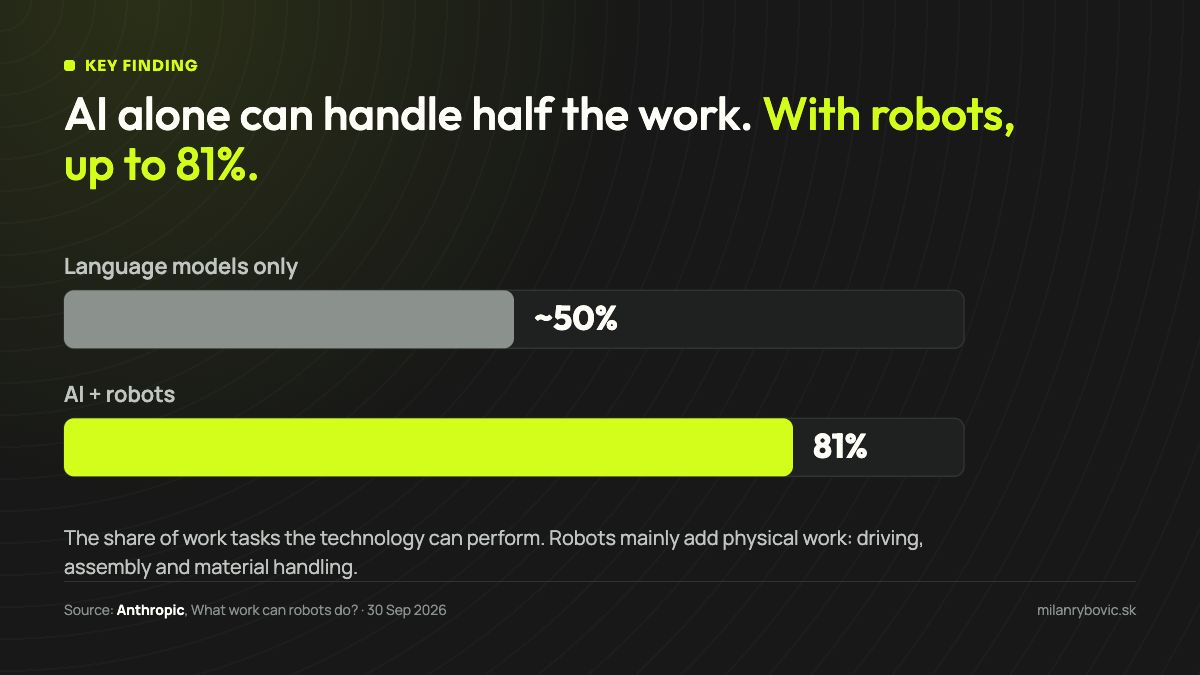
Most analyses of AI’s impact on work have focused on language models: what a chatbot can do. On 30 September 2026, Anthropic published What work can robots do?, the first study to add robots to the picture. That raised the share of work tasks the technology can perform from roughly half to 81%.
I went through the sectors one by one, looking at what is already happening in Slovakia, Czechia and neighbouring countries.
What the study actually measures
Authors Russell Legate-Yang and Maxim Massenkoff assessed individual work tasks according to whether a robot can perform them and in what setting. They distinguish four levels: a robot cannot do the task; it can do it in an environment built for robots, such as an assembly line; in a structured human environment, such as a warehouse; or in an unpredictable environment, such as a city street.
The study uses US occupational data. It finds that robots are already technically capable of performing 74% of physical tasks, which account for 34% of working time. The key word is “technically”. This is about capabilities, not what companies will actually deploy.
Why Slovakia should pay particular attention
Slovakia produces more cars per person than any other country in the world, nearly 196 per 1,000 people, and the automotive industry accounts for more than half of its industrial output. Back in 2018, the OECD concluded that Slovakia was the most exposed to automation of the 32 countries studied. 34% of jobs face a high risk of automation, while another 31% face substantial changes to the work they involve.
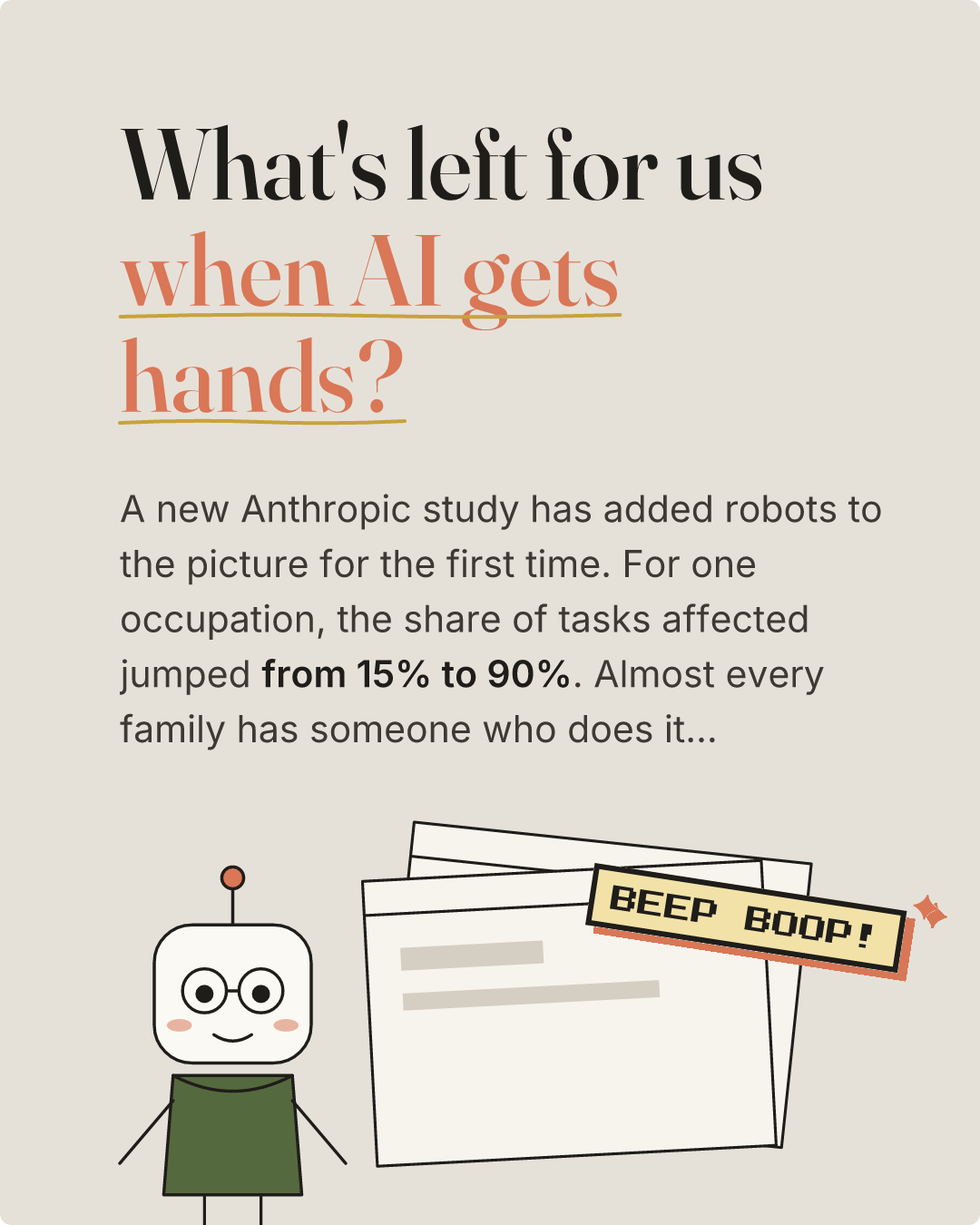
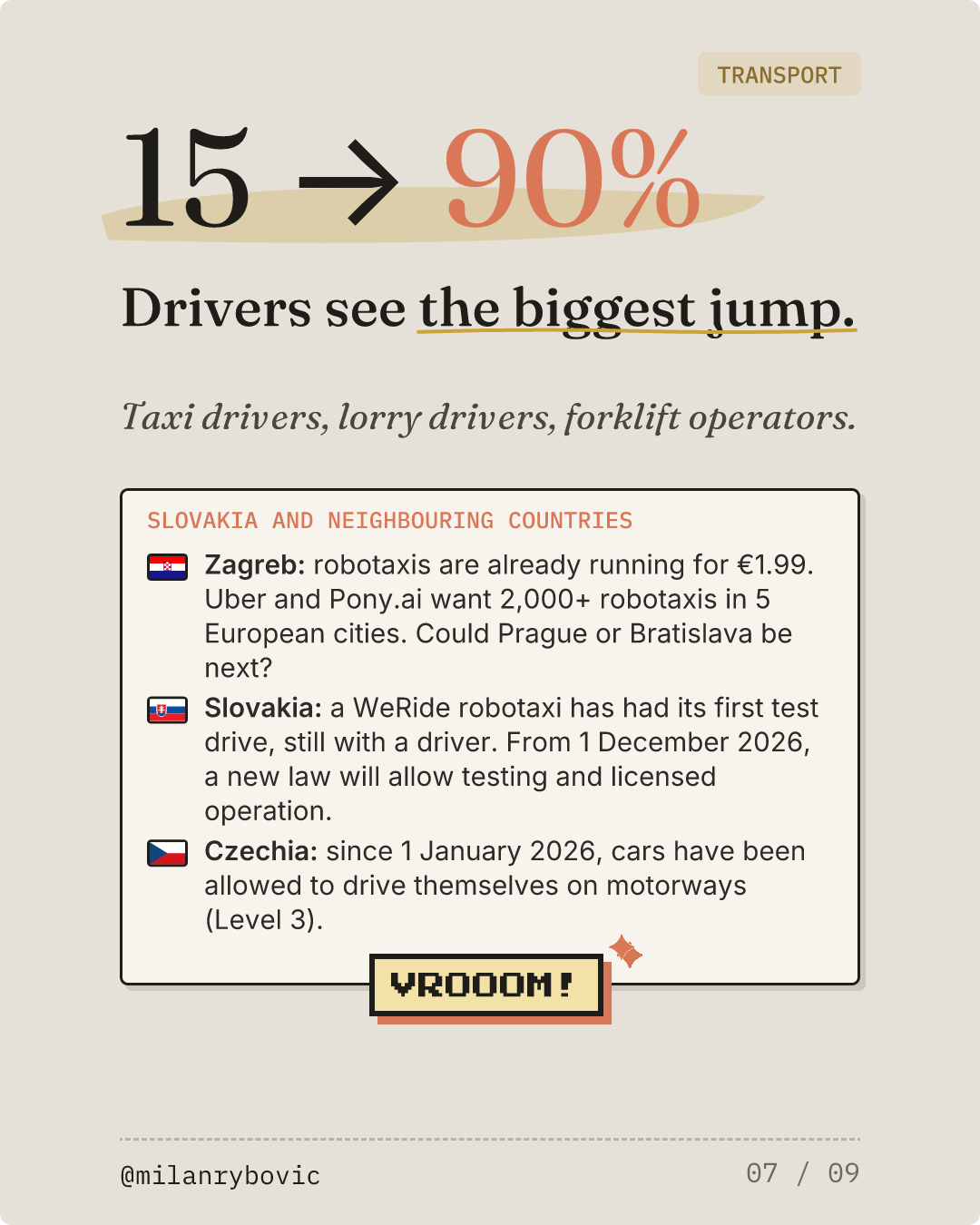
Drivers: from 15% to 90%
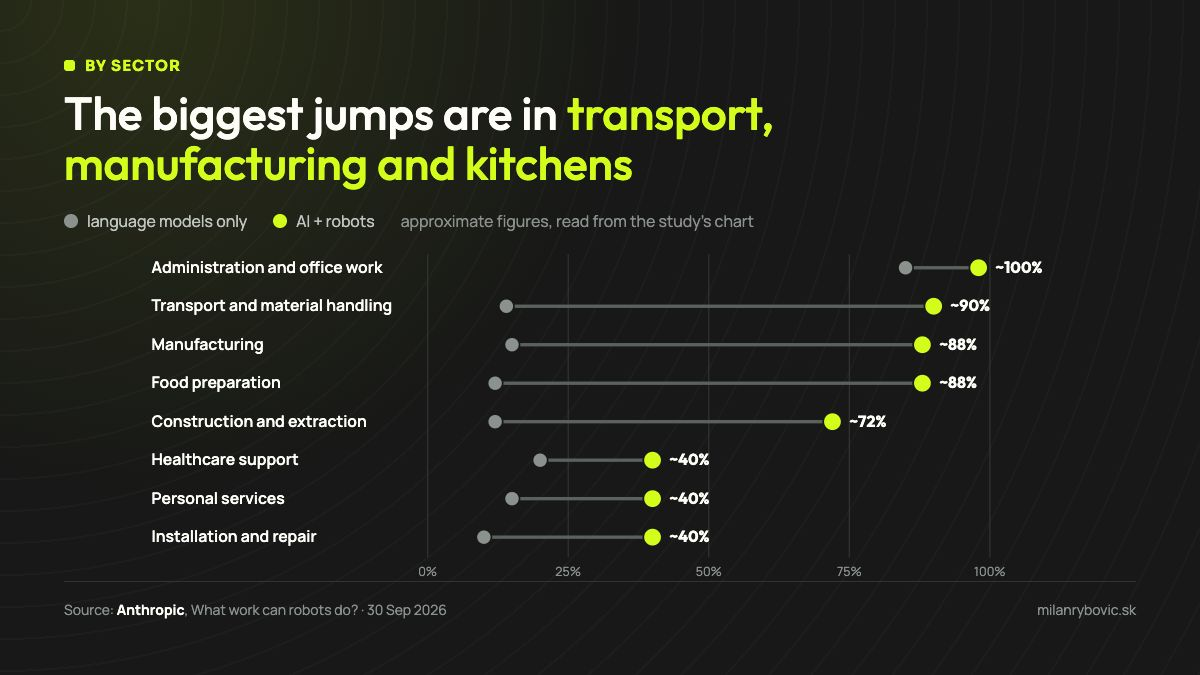
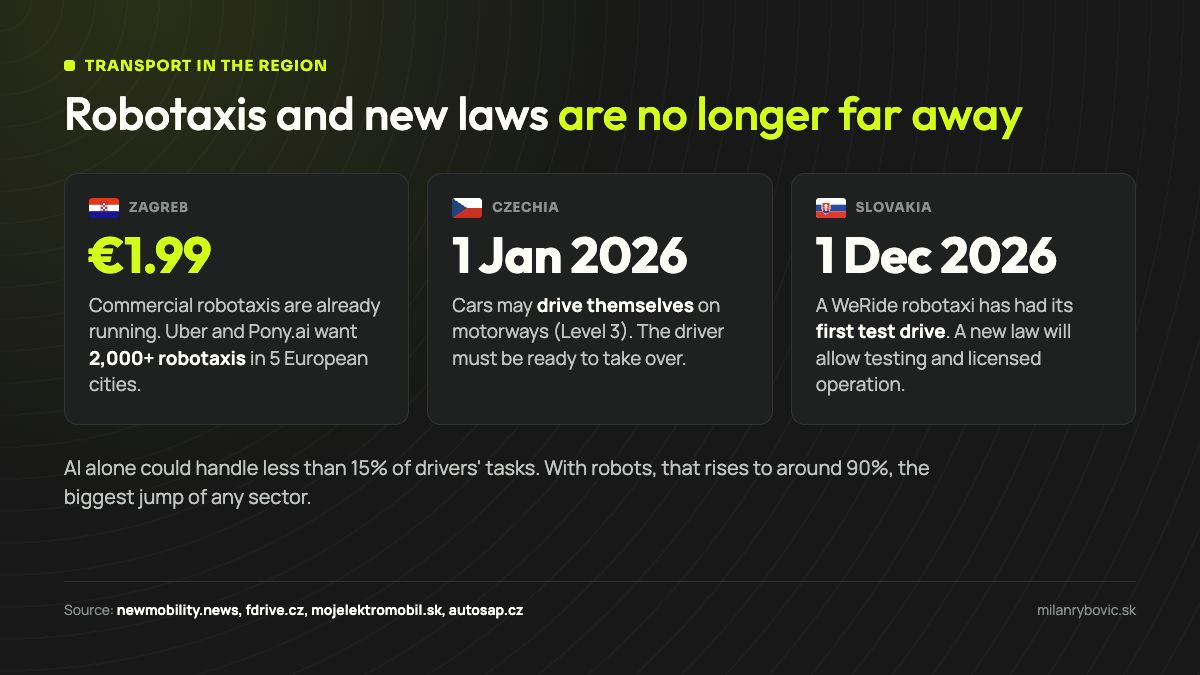
Transportation and material handling show the biggest jump of any sector. Language models alone could handle less than 15% of drivers’ tasks; with robots, that rises to around 90%. This includes taxi drivers, lorry drivers and forklift operators.
Robotaxis are no longer just an American story. In Zagreb, Verne’s commercial robotaxi service charges a flat fare of €1.99, for now with an operator in the vehicle. Uber and Chinese company Pony.ai are planning more than 2,000 robotaxis across five European cities. Apart from Zagreb, the cities have not yet been named. Tests are under way in Munich and Berlin.
In Slovakia, August saw the first test drive of a robotaxi from Chinese company WeRide, still with a safety driver behind the wheel. On 1 December 2026, a law allowing tests of automated vehicles in a secured area will take effect, followed by operation under a Ministry of Transport licence and with police approval. In Czechia, since 1 January 2026, cars have been allowed to drive themselves at Level 3 on selected road sections, mainly motorways. The driver must be ready to take over within 10 seconds.
The context matters. Slovakia currently has a shortage of around 8,000 professional drivers, Czechia is short of up to 20,000, and across Europe the shortfall is around 502,000, according to the IRU. In their first wave, autonomous vehicles are therefore likely to fill vacancies rather than displace existing workers.
Factories, warehouses and kitchens
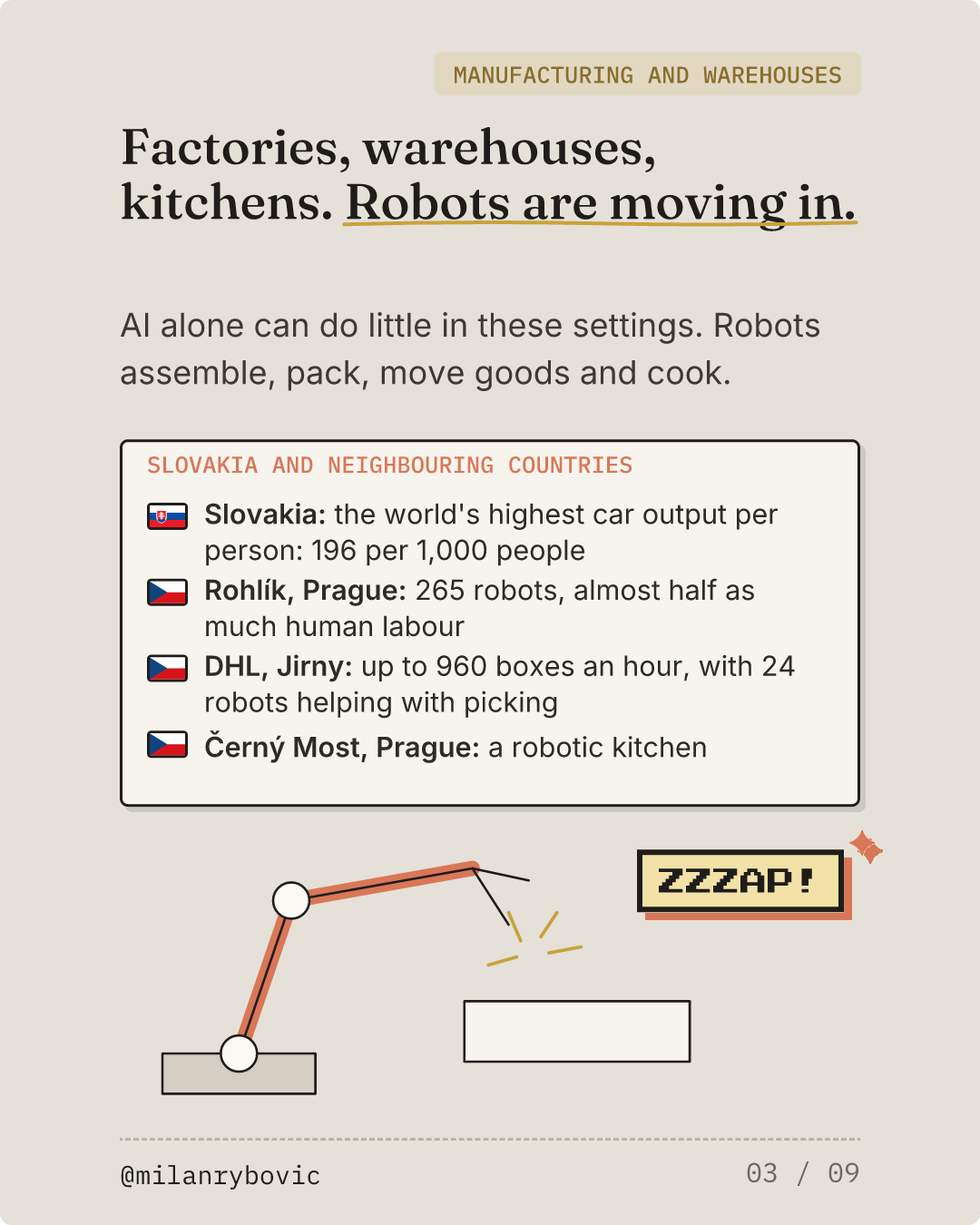
In manufacturing, language models cover only a small share of tasks. Robotics adds assembly, welding, packaging and material handling. The study finds a similarly large jump in food preparation.
Examples from the region: Rohlík’s warehouse in Chrášťany near Prague has deployed 265 robots and requires almost half as much human labour as its older warehouses. DHL in Jirny has launched a packaging line that folds and seals up to 960 boxes an hour, which the company says is equivalent to the output of up to 35 employees. 24 robots help with order picking. At Westfield Černý Most in Prague, iFood’s robotic kitchen is cooking meals, while Volvo’s new plant near Košice will get automated final assembly technology from German company Dürr.
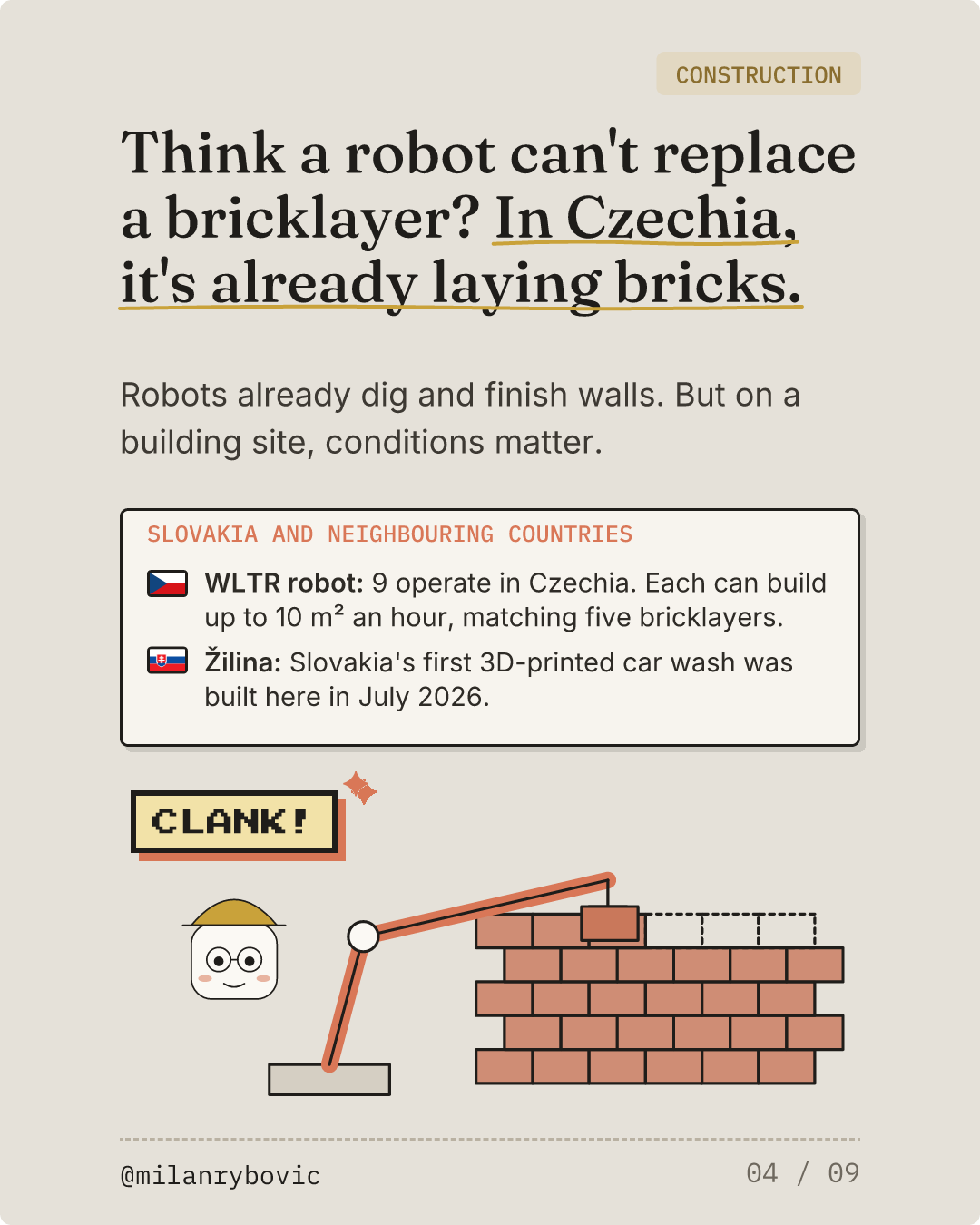
Construction: robots are already laying bricks
Robots can handle some excavation and wall finishing. US construction equipment manufacturer JLG acquired Canvas in January 2026, whose robot applies filler to drywall and sands it on its own. But conditions on site matter, and every site is different, which is why construction scores lower than factories.
In Czechia, Wienerberger operates nine WLTR bricklaying robots. Each can build up to 10 m² of wall an hour, matching the pace of five bricklayers. In July 2026, Žilina became home to Slovakia’s first 3D-printed car wash, while on an apartment building site in Prague, a robot printed an entire room in concrete in two hours.
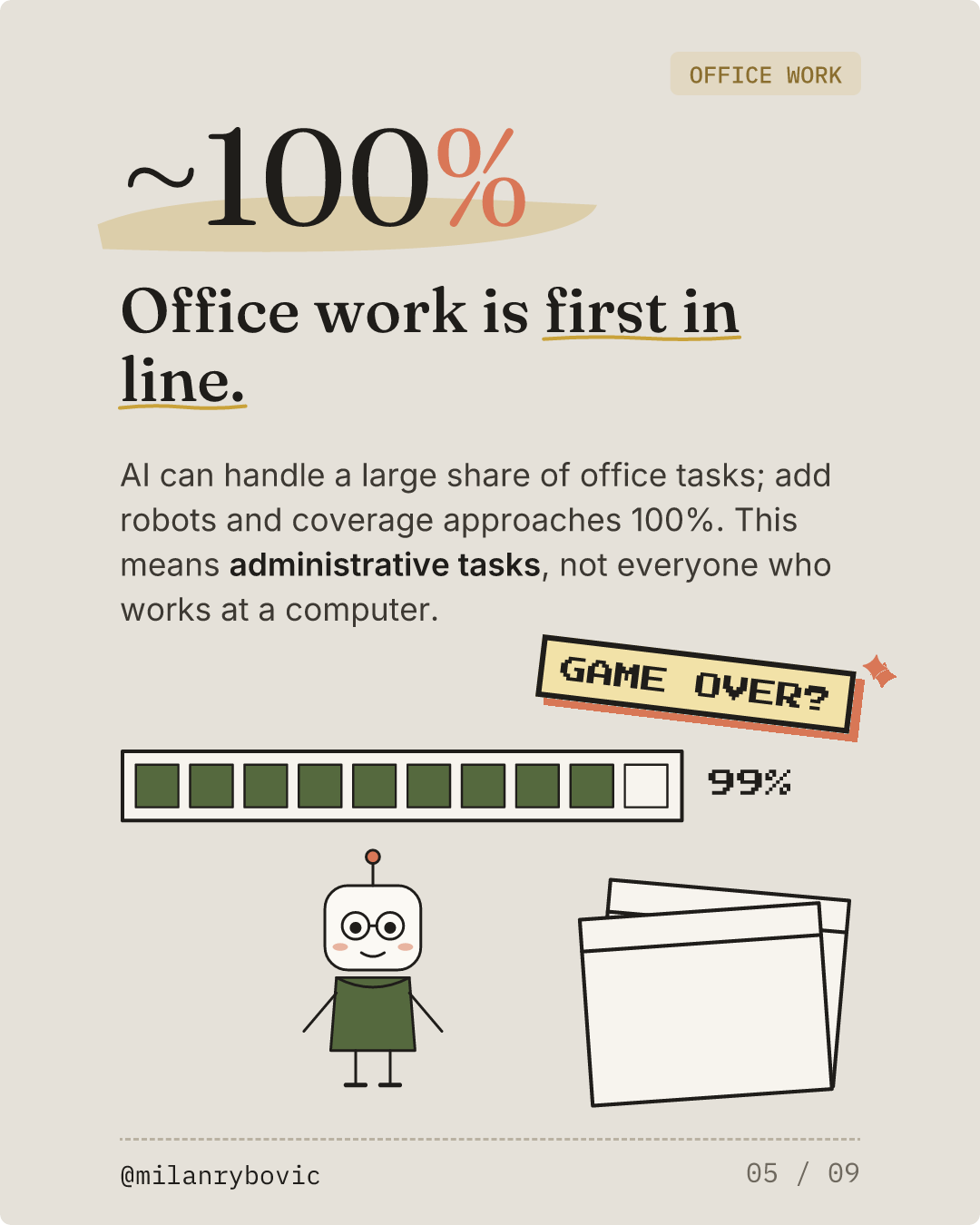
Office work: almost 100%
Language models can already handle a large share of administrative and office support tasks. Add robots and coverage approaches 100%. This refers to administrative tasks, not everyone who works at a computer.
Banks are already factoring this into their plans. British bank Standard Chartered has announced plans to cut almost 8,000 jobs in administrative centres, replacing them with AI. Analysts estimate that European banks could reduce their workforces by 10% to 20% over five years.
Where machines struggle
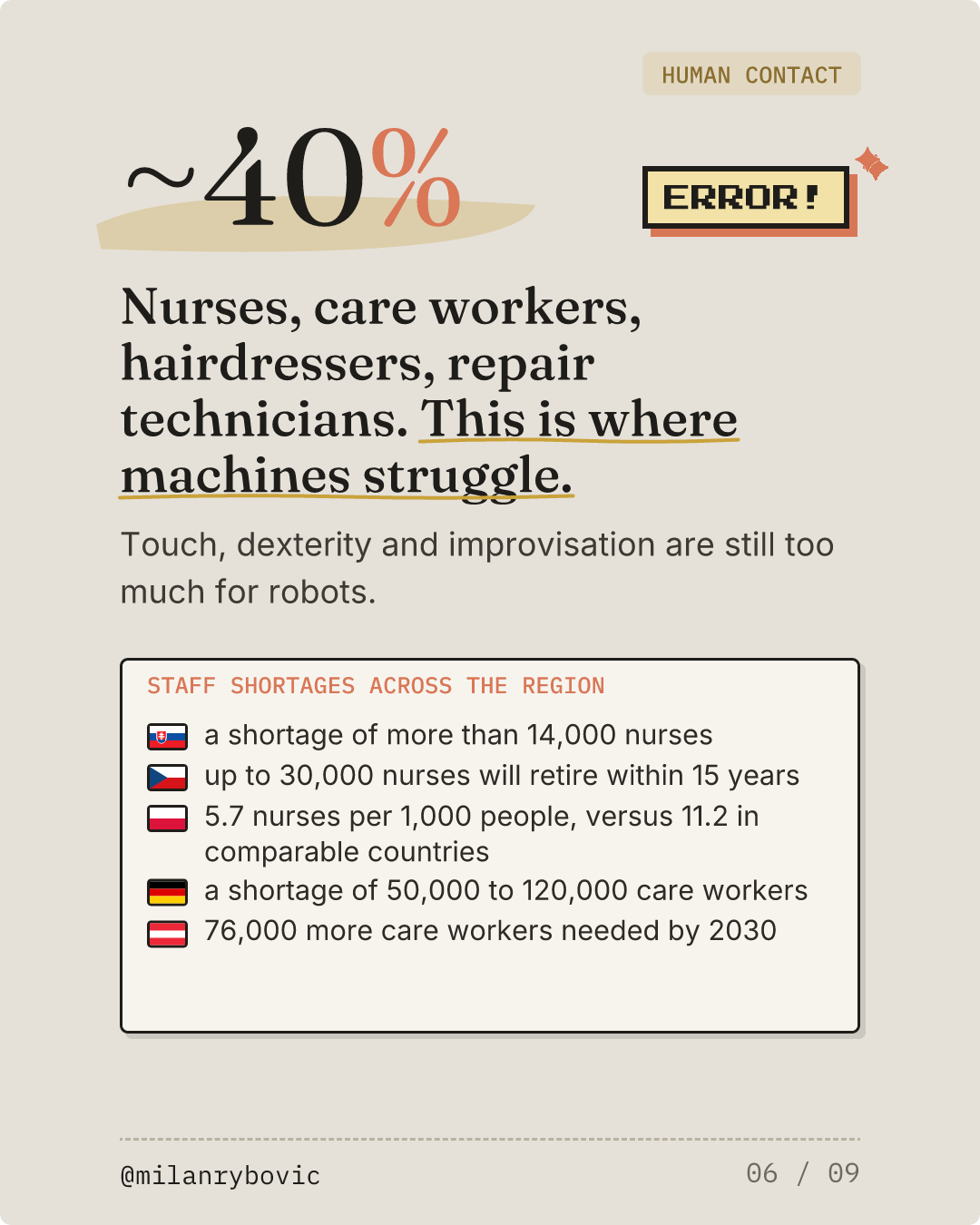
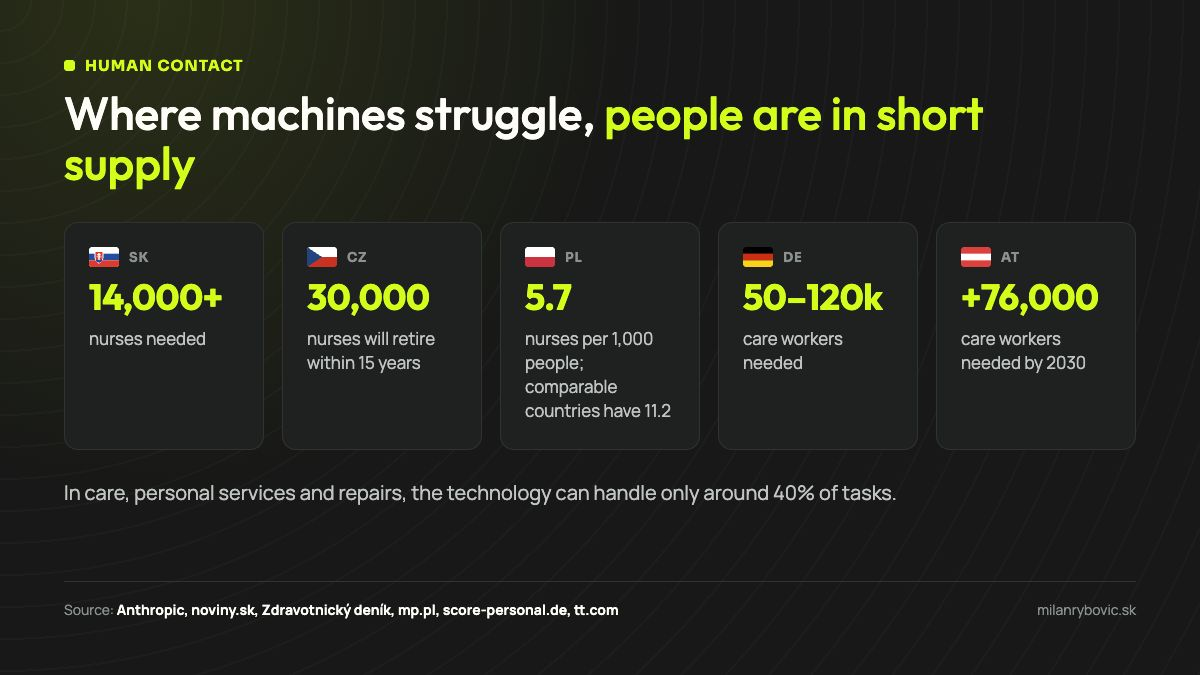
Healthcare support, personal services, and installation and repair have the lowest figures, at around 40% of tasks. Human touch, fine motor skills and unpredictable situations are still too much for robots. Yet these are precisely the professions facing staff shortages across the region:
- Slovakia is short of more than 14,000 nurses.
- In Czechia, up to 30,000 nurses will retire within 15 years.
- Poland has 5.7 nurses per 1,000 people, compared with 11.2 in comparable countries.
- Germany is short of 50,000 to 120,000 care workers.
- By 2030, Austria will need 76,000 more care workers.
Why 81% does not mean 81% of workers losing their jobs
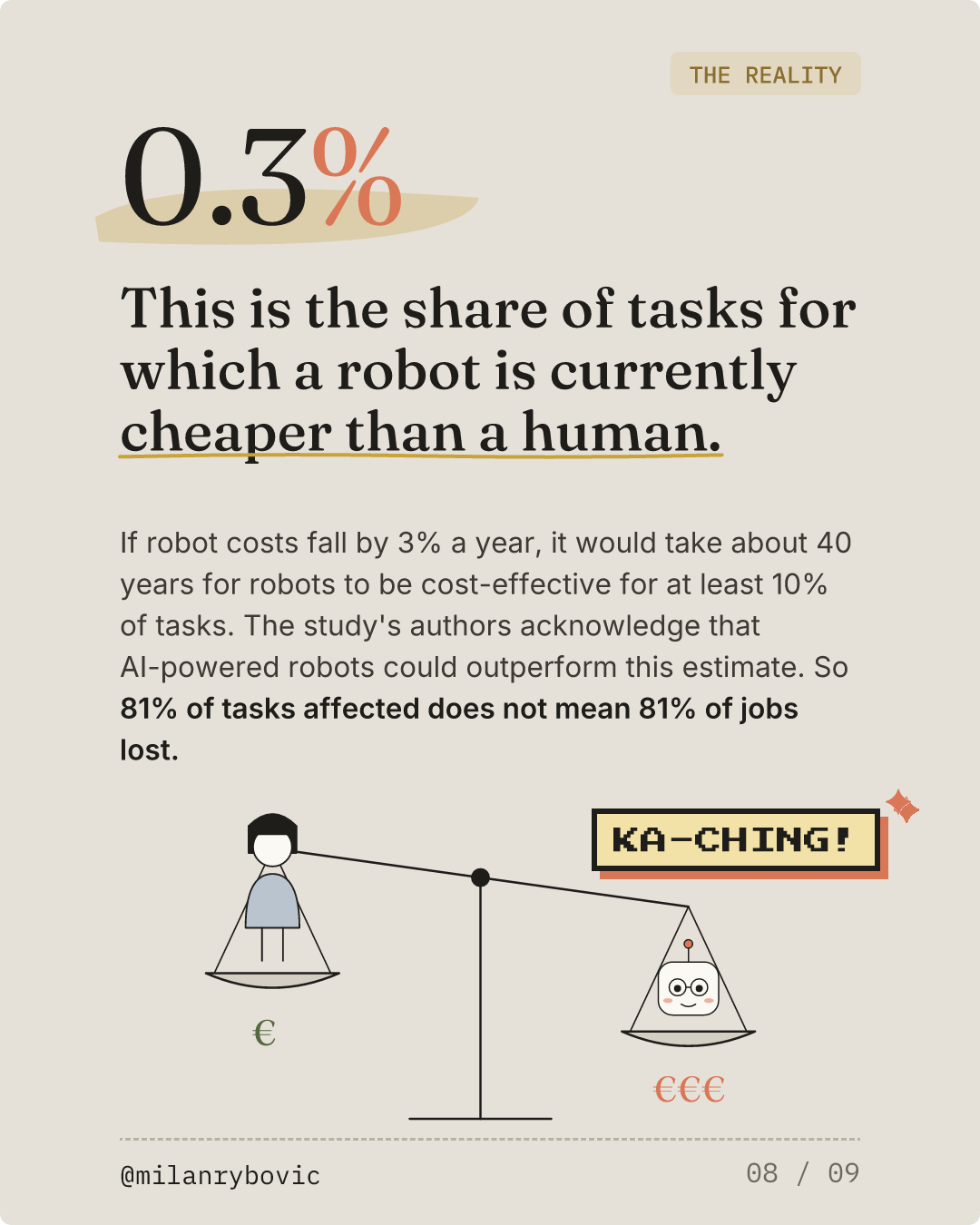
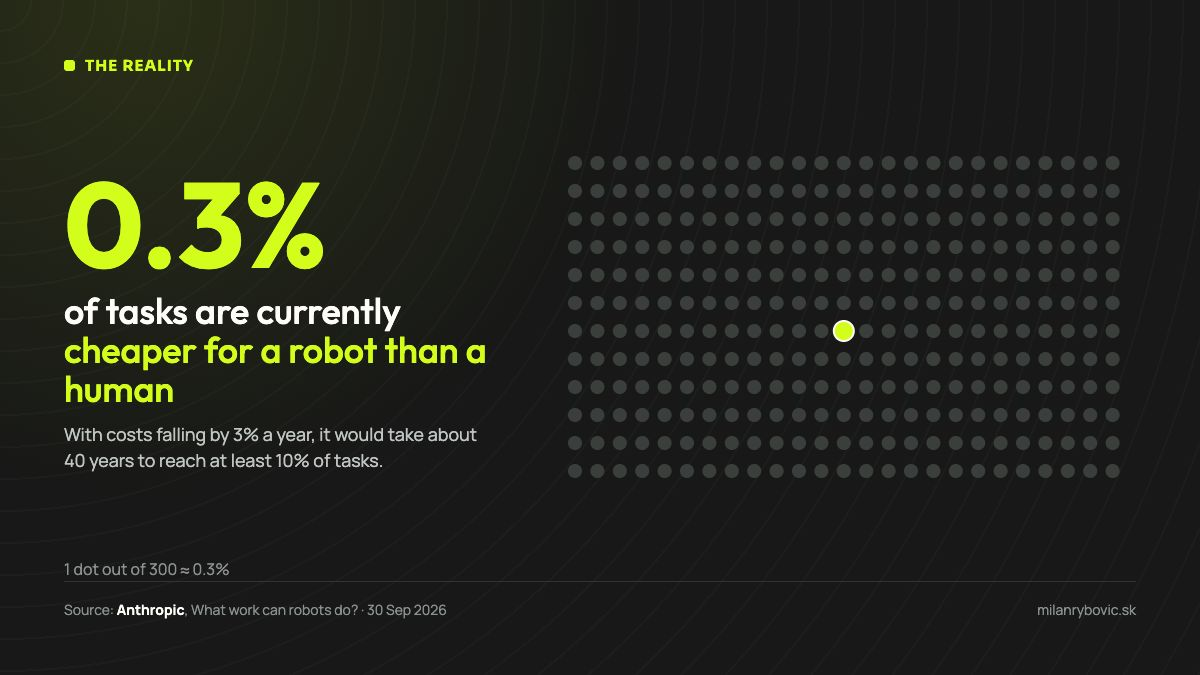
The study’s most important figure is 0.3%. That is the share of tasks for which a robot is currently cost-competitive with a human. If robot costs keep falling at their historical rate of around 3% a year, it would take about 40 years for this to be true of at least 10% of tasks.
The authors also point out that AI-powered robots could outperform this estimate and learn to do things they cannot do today. There is no certainty in either direction.
The study also shows who is most exposed to robotics. Workers in the most exposed occupations are more likely to be men with lower levels of education and lower pay, and their unemployment rate is more than twice that of other workers.
What to take away
Companies in logistics, manufacturing and transport should watch how quickly robot prices fall. Where staff are scarce, automation may pay off sooner than the average suggests, especially in warehouses and on production lines.
In the office, AI is already changing work. Those who stand to gain most know how to use it for routine tasks, freeing up time to work with people, make decisions and check results.
In care, healthcare and the skilled trades, more people will be needed. Technology is more likely to help with the administration around the job than with the work itself.
Sources
- Anthropic: What work can robots do? (30 September 2026)
- OECD / Intellinews: Slovak workers most likely to be replaced by robots
- Startitup: Slovakia produces 196 cars per 1,000 people
- newmobility.news: Robotaxis in Zagreb
- fDrive: Uber and 2,000 robotaxis in Europe
- mojelektromobil.sk: The first robotaxi test drive in Slovakia
- mojelektromobil.sk: The law on autonomous cars
- autosap.cz: Czech legislation on autonomous driving
- cargomagazin.sk: Driver shortages in Slovakia and Czechia
- transport-online.de: The IRU on driver shortages
- CzechCrunch: Rohlík and warehouse robots
- DHL: An automated packaging line in Jirny
- Apetit: A robotic kitchen at Černý Most
- Autocar Pro: Dürr and Volvo’s Košice plant
- ENR: JLG acquires Canvas
- České stavby: The WLTR bricklaying robot
- Feedit: A 3D-printed car wash in Žilina
- Skanska: A robot printed a room in 2 hours
- SME: Standard Chartered to cut almost 8,000 jobs
- Forbes Slovensko: AI and European banks
- Noviny.sk: Slovakia is short of 14,000 nurses
- Zdravotnický deník: Nurses heading into retirement
- mp.pl: Nurse numbers in Poland
- score-personal.de: Germany’s care worker shortage
- Tiroler Tageszeitung: Austria needs 76,000 care workers