

The V4 countries are Slovakia, Czechia, Poland and Hungary.
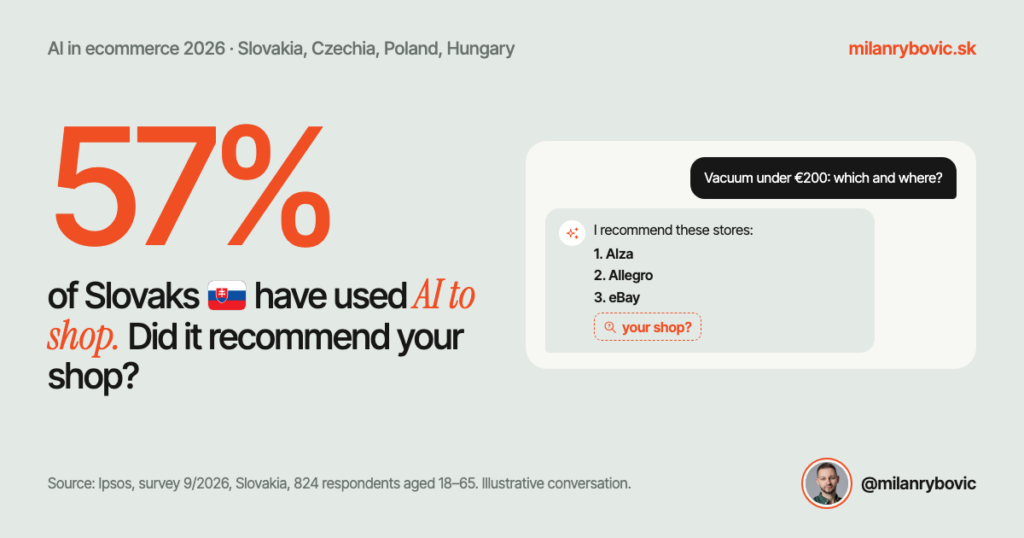
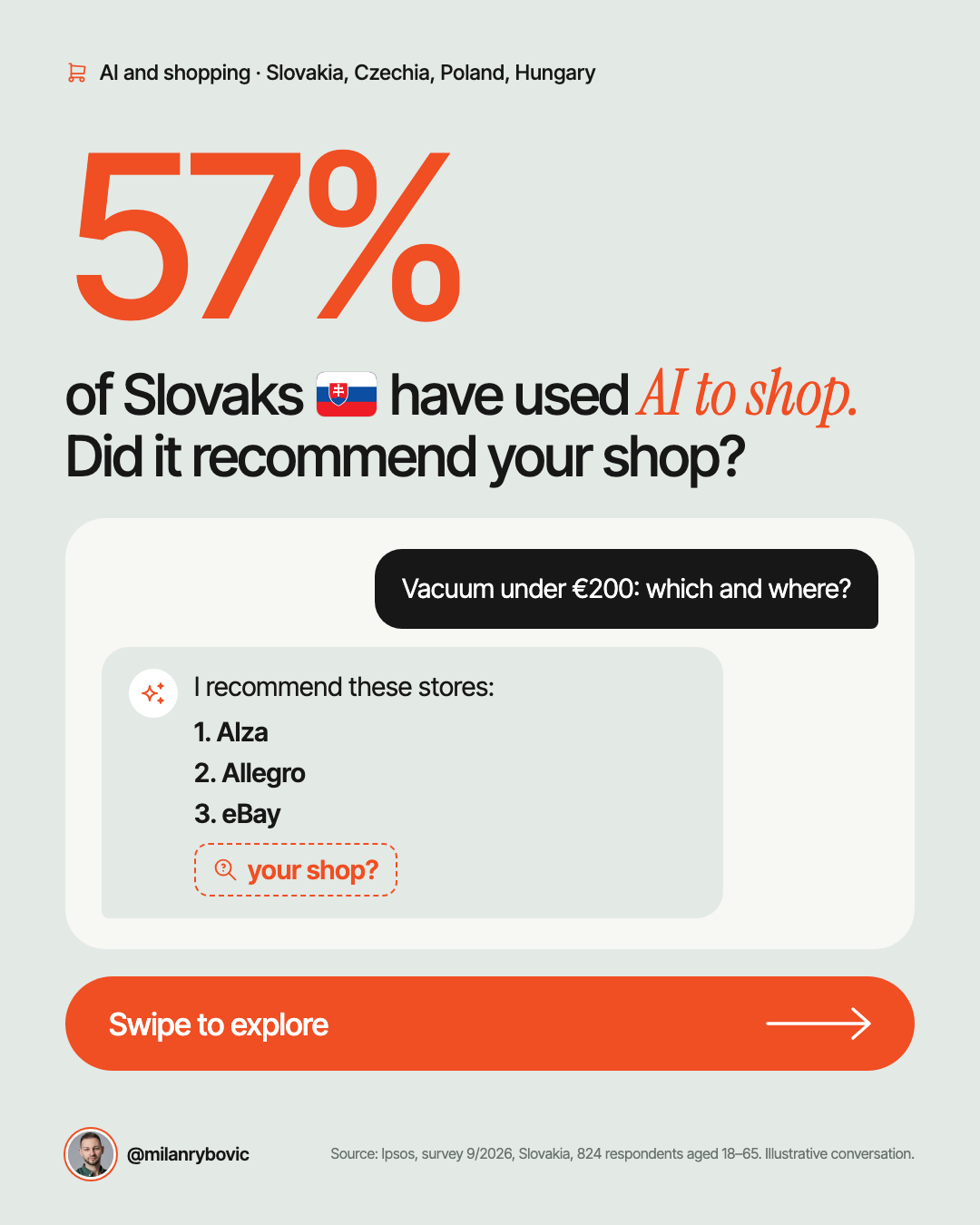
57% of Slovaks have asked artificial intelligence for shopping advice in the past six months. They ask which product to choose, how two models differ or what the reviews say. Yet only 29.8% of them trust AI’s recommendations. And when AI recommends stores, it mentions fewer than a tenth of the online stores on the market.
I’ve brought together fresh data from Slovakia, Czechia, Poland and Hungary. It comes from Eurostat, research agencies Median, Ipsos and Gemius, the APEK association and measurements taken directly from online stores. In this article, you’ll find out how quickly the number of AI users is growing, how they use it when shopping, who they trust and how many orders AI is already bringing online stores. At the end, you’ll find 6 steps to help AI recommend your business too.
The key numbers at a glance
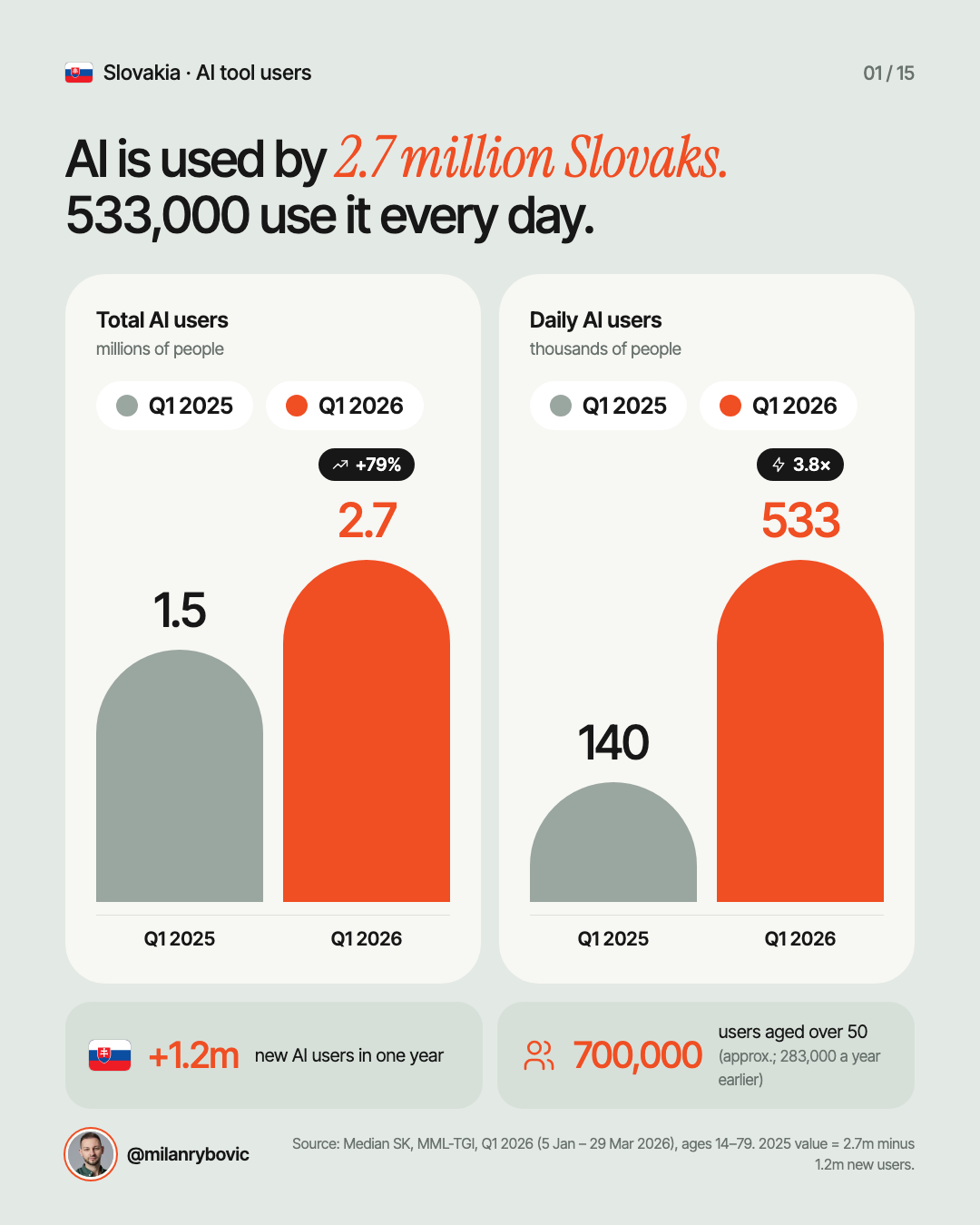
- 2.7 million Slovaks use AI tools, up by 1.2 million from a year ago. There are 533,000 daily users.
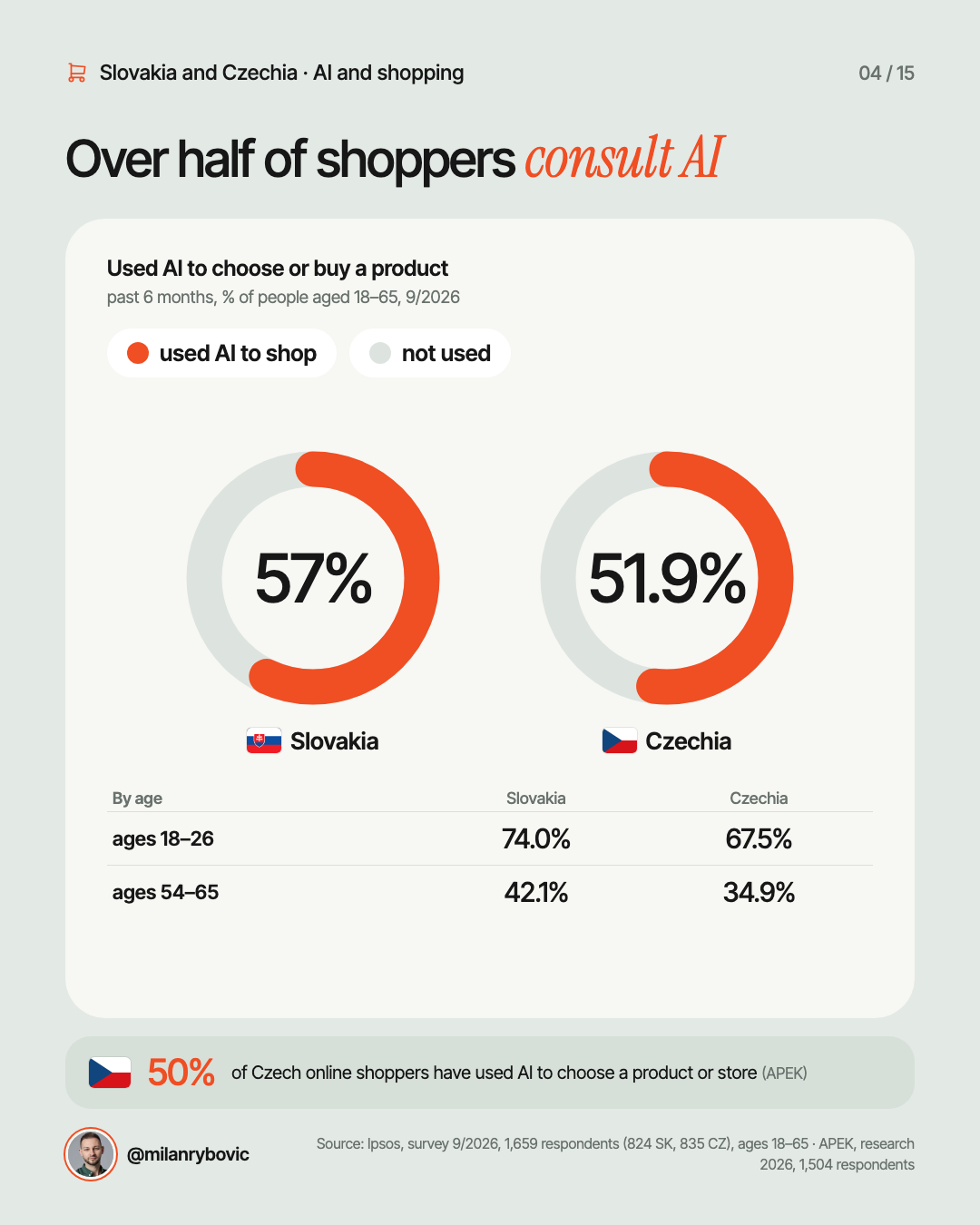
- 57% of Slovaks and 51.9% of Czechs have used AI to choose or buy a product.
- 29.8% of Slovaks and 22.3% of Czechs trust AI recommendations.
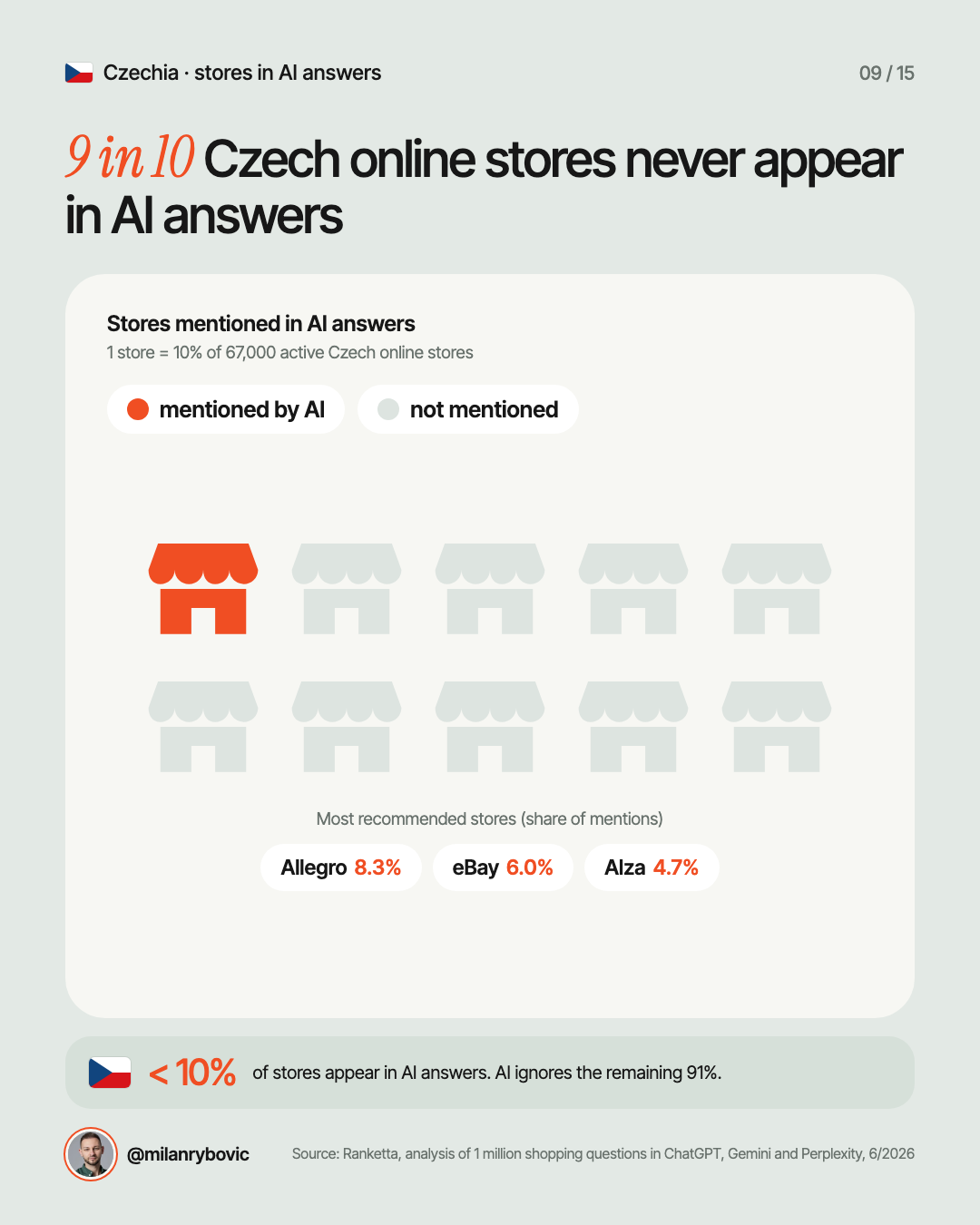
- AI mentions fewer than 10% of the 67,000 active Czech online stores in its answers.
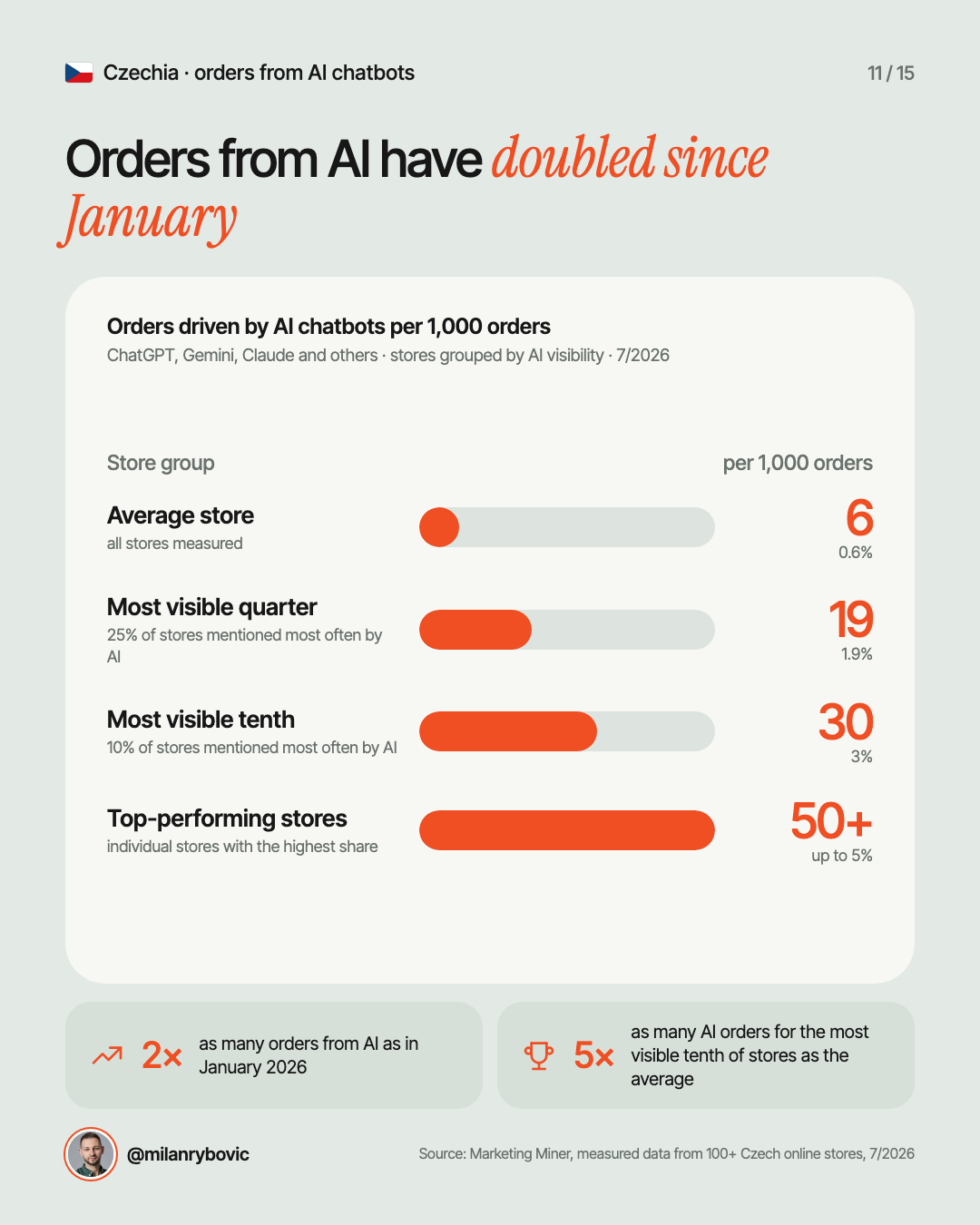
- Orders from AI chatbots have doubled since January 2026. For now, the average online store gets 6 orders out of 1,000 from them.
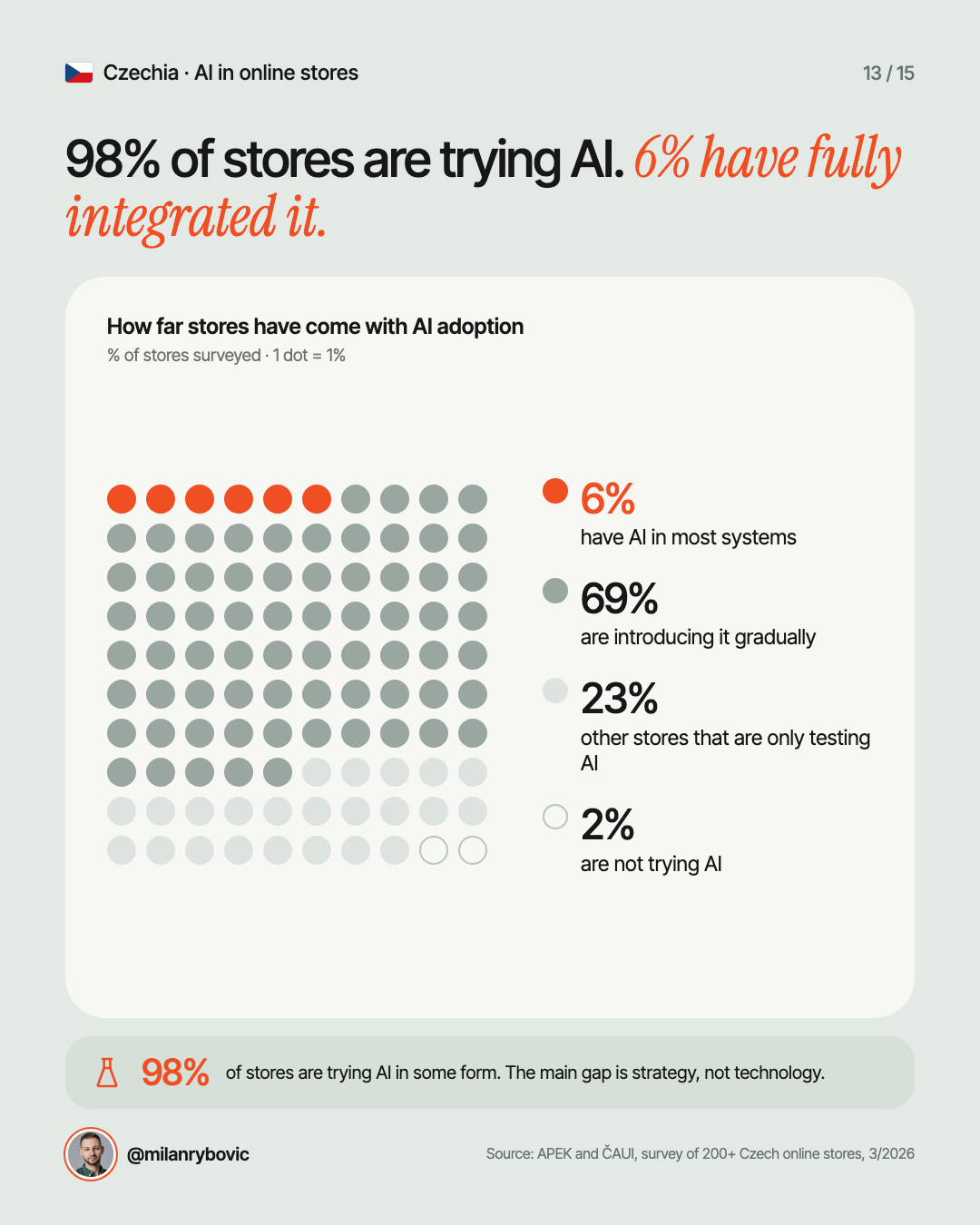
- 98% of Czech online stores are trying AI, while 6% have fully integrated it into their processes.
How many people in Slovakia and the V4 use AI
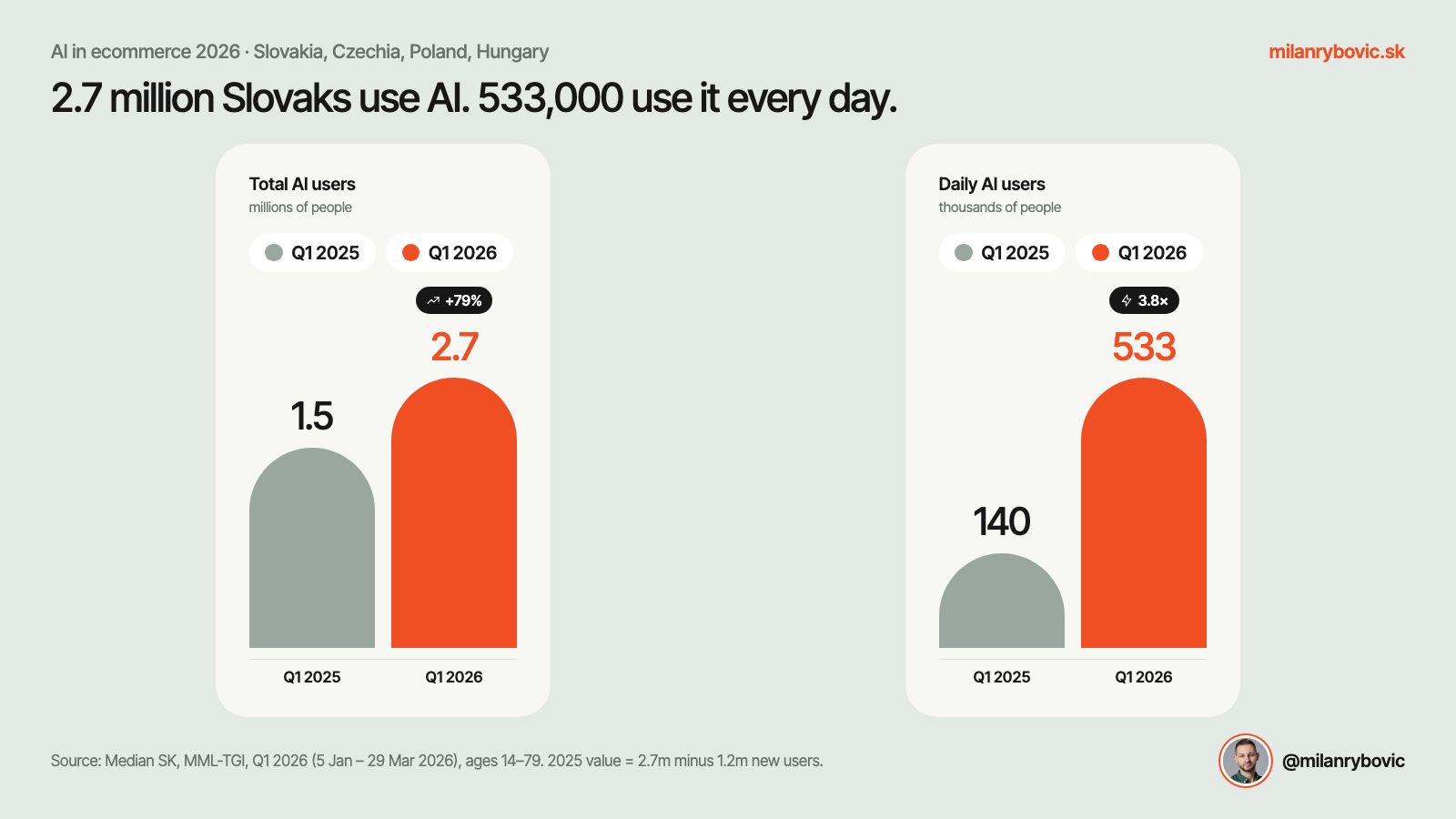
In Slovakia, 2.7 million people aged 14 to 79 use AI tools. That number has grown by 1.2 million in a year, an increase of 79%. The number of people who open AI tools every day is growing even faster: from 140,000 in the first quarter of 2025 to 533,000 in the first quarter of 2026, almost a fourfold increase. AI is no longer just for young people. There are around 700,000 users over 50, compared with 283,000 a year earlier.
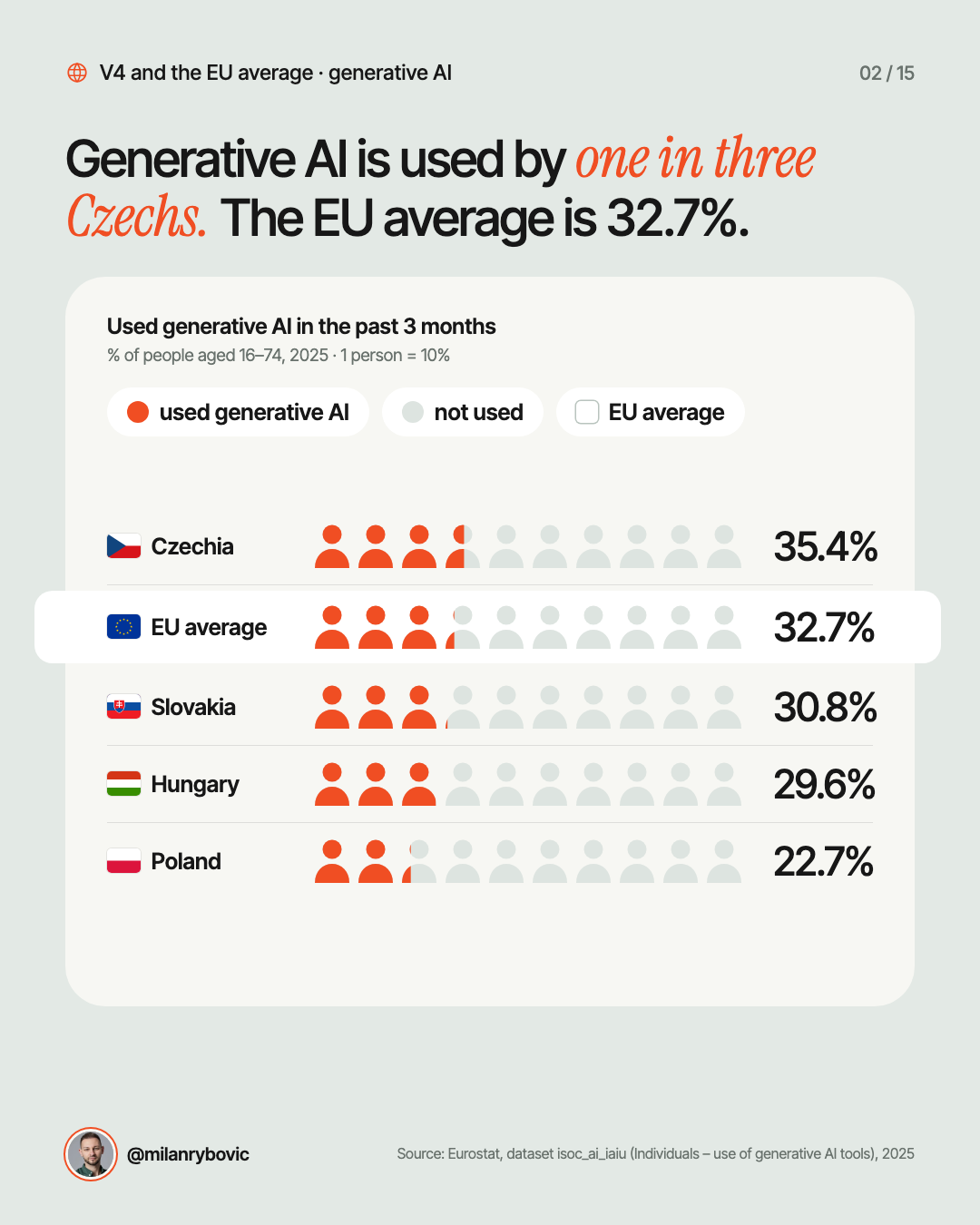
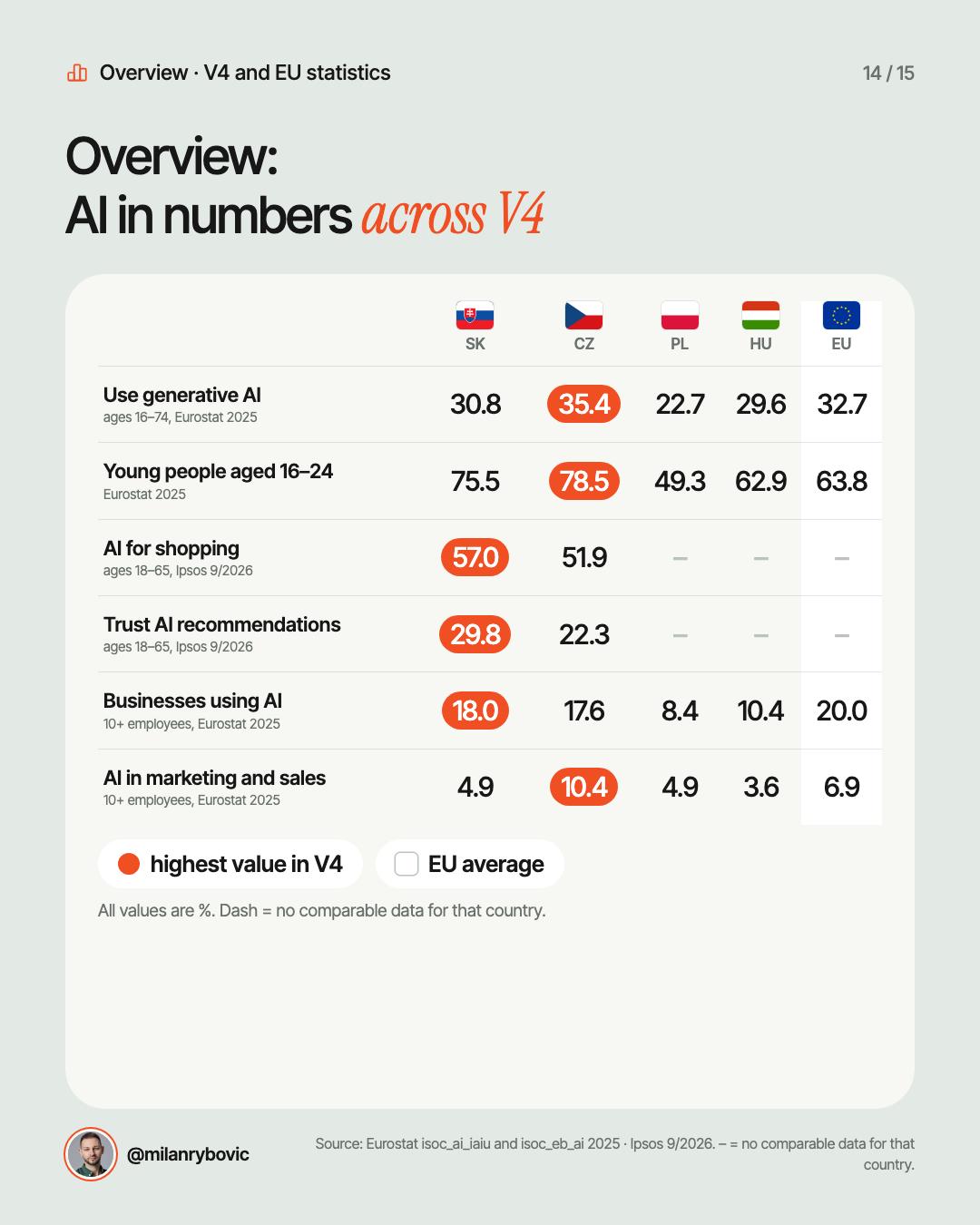
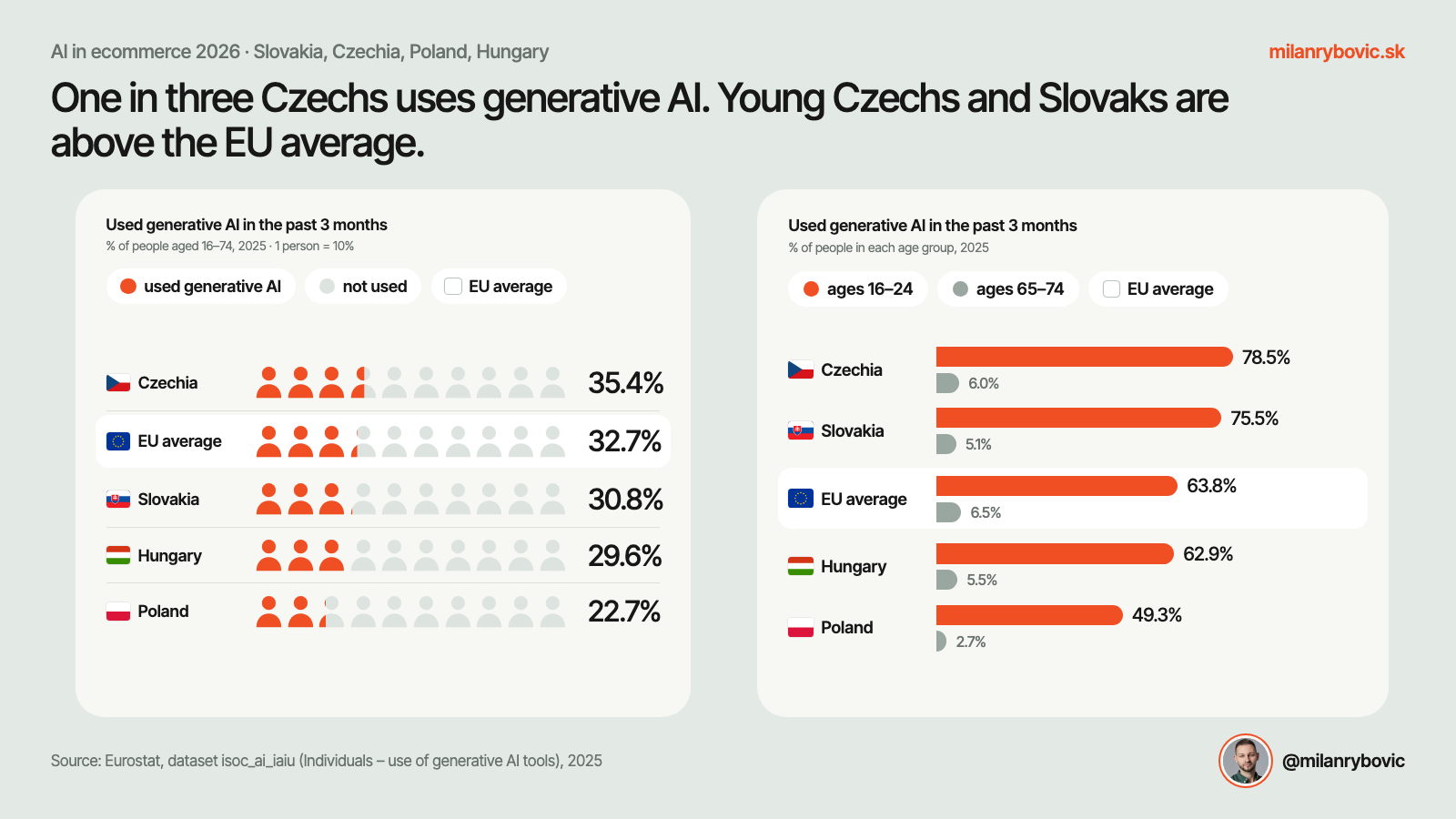
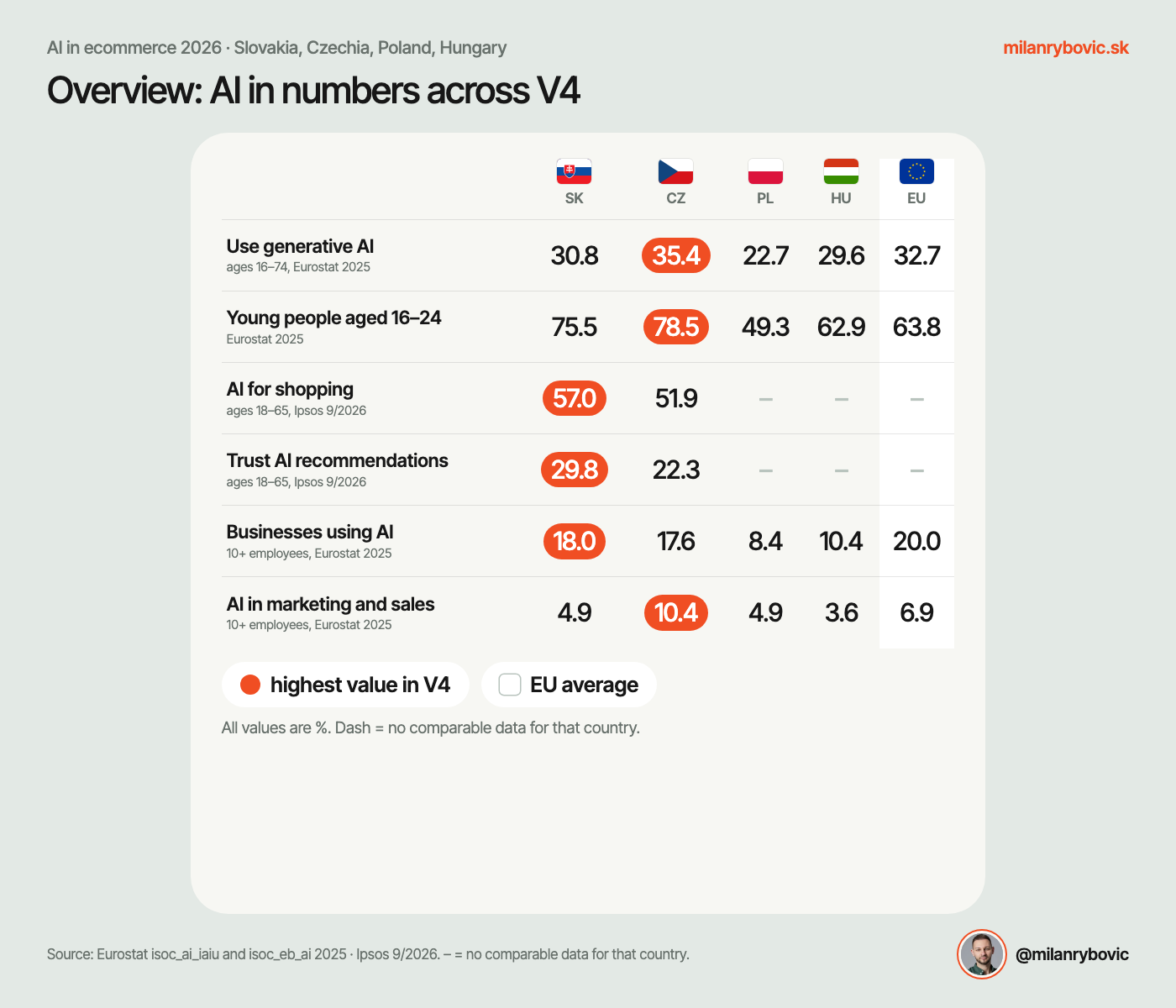
Eurostat provides comparable data for the whole V4. In 2025, one in three Czechs (35.4%) had used generative AI in the past three months, above the EU average of 32.7%. Slovakia (30.8%) and Hungary (29.6%) were just below the average, while Poland (22.7%) trailed it by 10 percentage points.
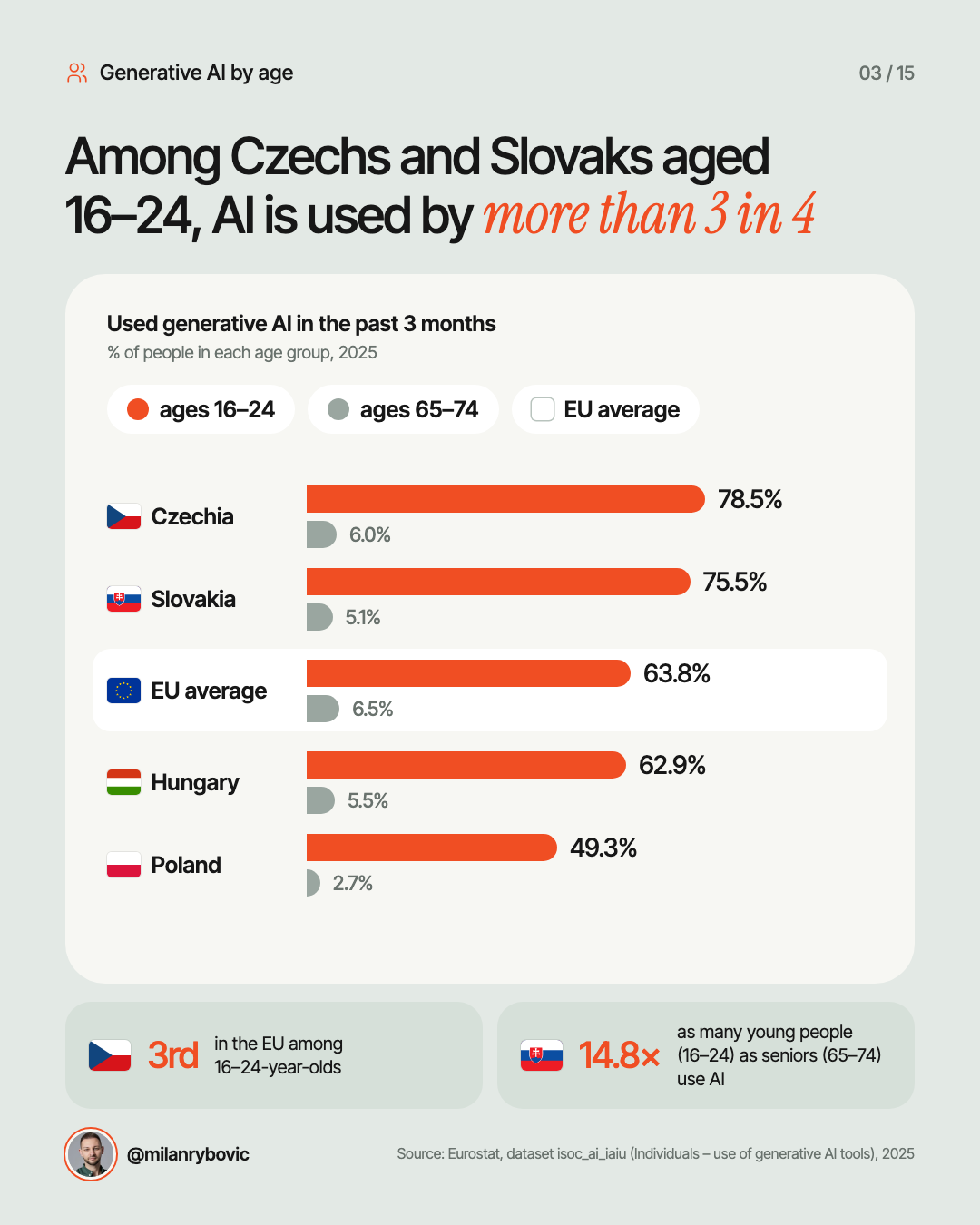
Age makes the biggest difference. Among 16- to 24-year-olds, 78.5% of Czechs use generative AI, the third-highest share in the EU, along with 75.5% of Slovaks. The EU average for this age group is 63.8%. Among 65- to 74-year-olds, the figure is just 3 to 6% in all V4 countries.
AI for shopping: more than half ask AI first
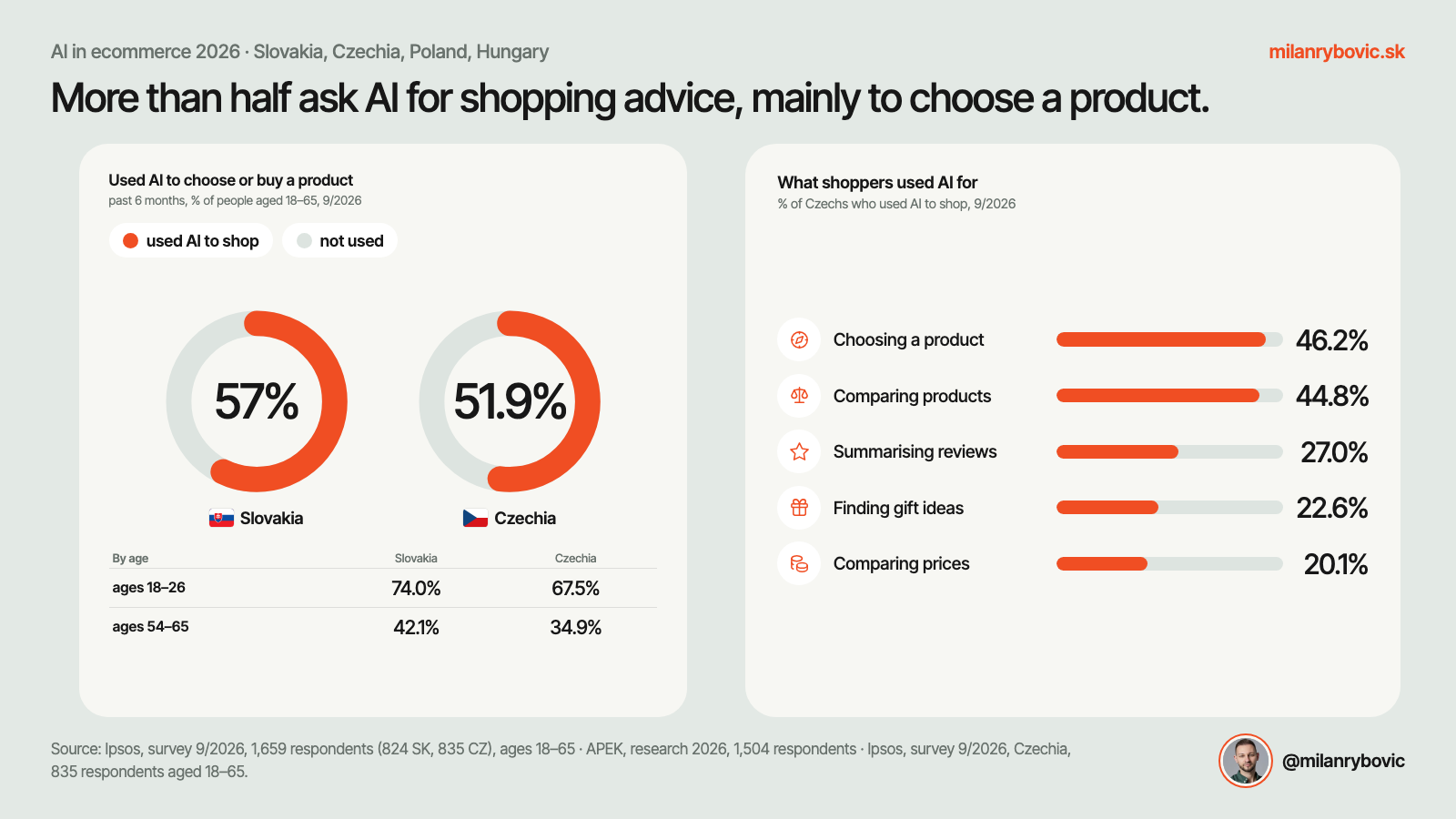
An Ipsos survey from September 2026 asked specifically about shopping. In the past six months, 57% of Slovaks and 51.9% of Czechs aged 18 to 65 had used AI to choose or buy a product. Among Slovaks aged 18 to 26, the figure was 74%, but even in the 54 to 65 age group, 42.1% had asked AI for advice.
Czech research by APEK found a similar figure: 50% of online shoppers had already used AI to help them choose a product or an online store.
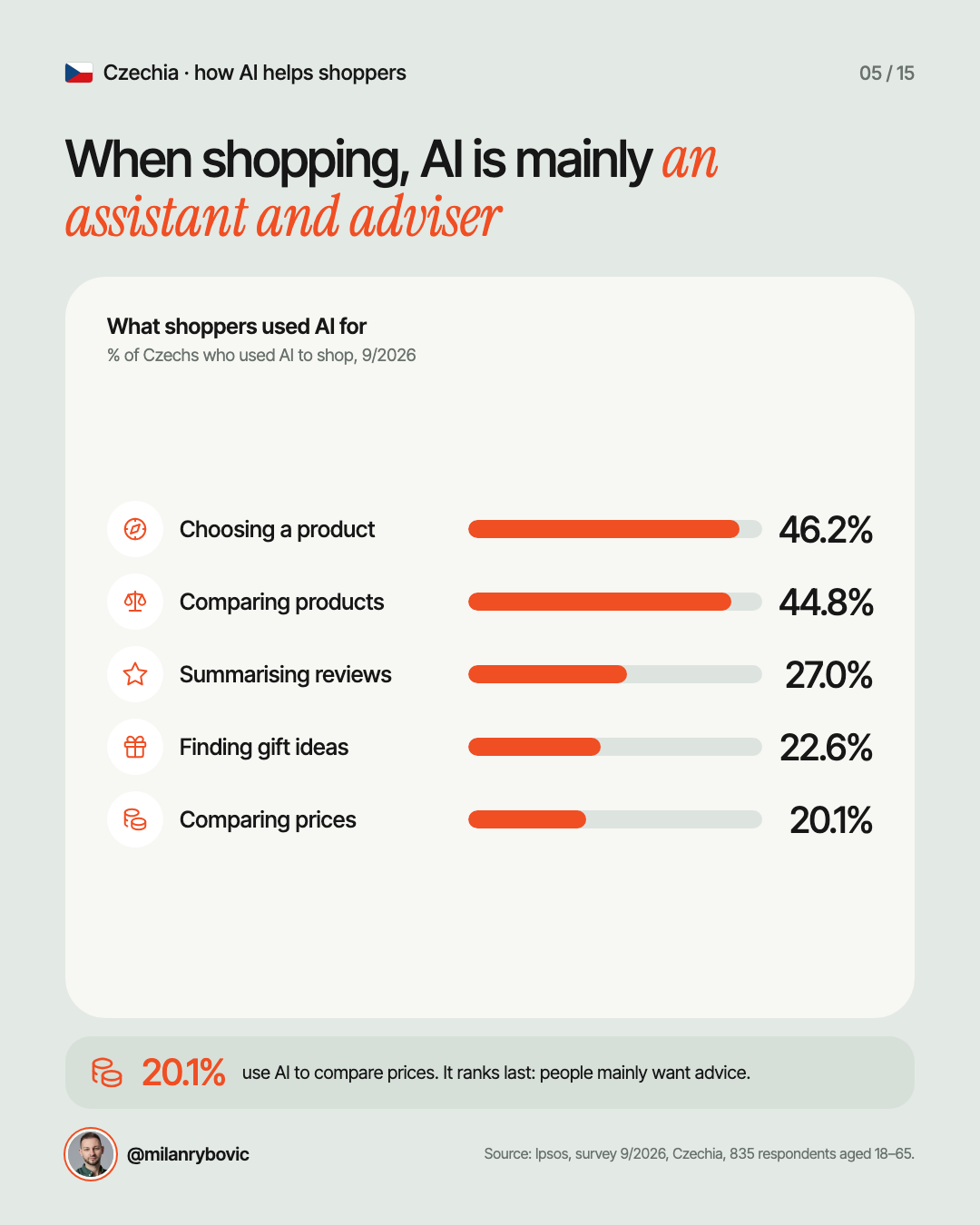
What’s interesting is how people use it. Most often, AI helps them choose a product (46.2%) or compare products (44.8%). It also summarizes reviews (27%) or suggests gift ideas (22.6%). Price comparison comes last (20.1%). So when people shop, AI mainly acts as a salesperson and adviser, not a price comparison tool.
Trust: people ask AI, but far fewer trust it
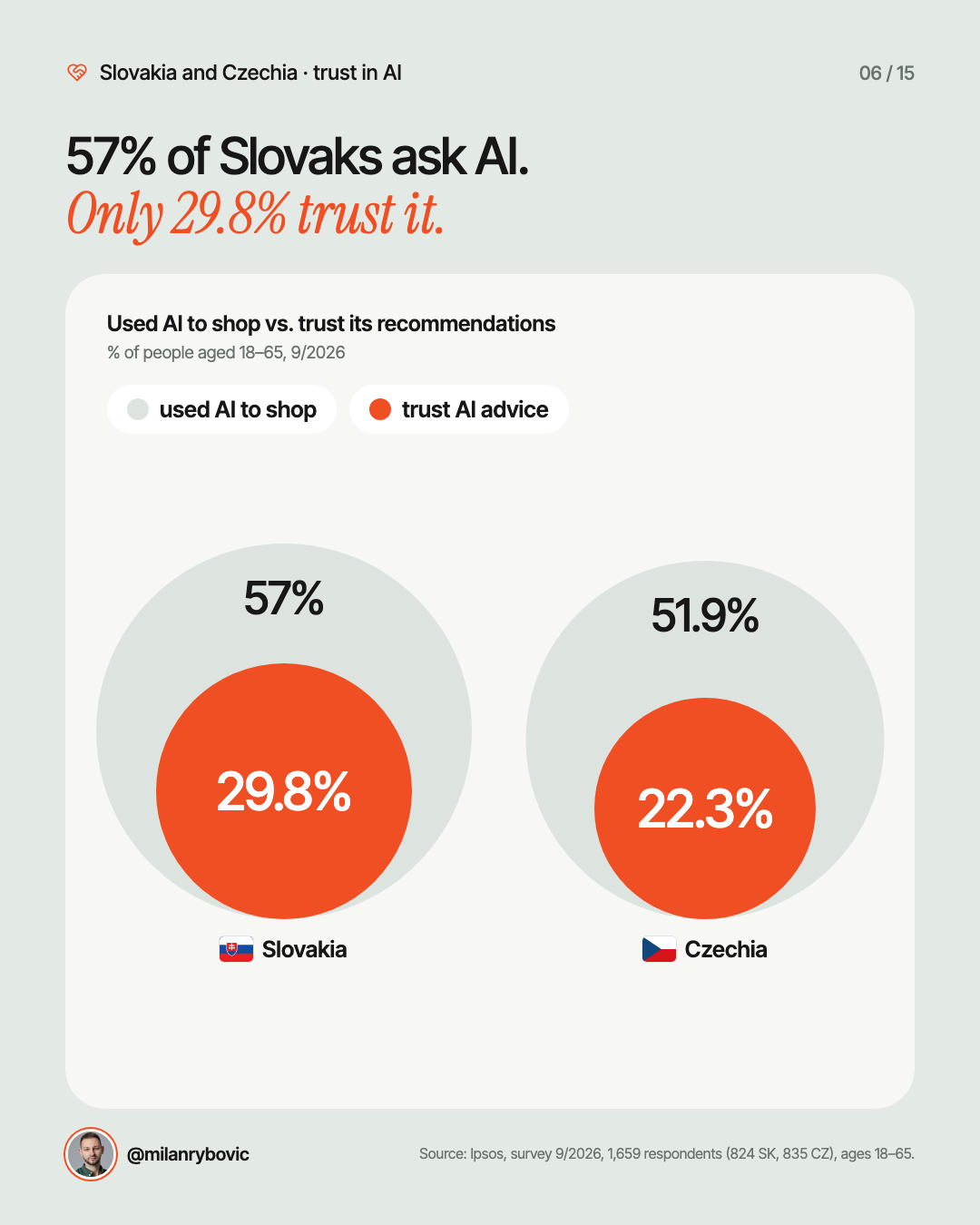
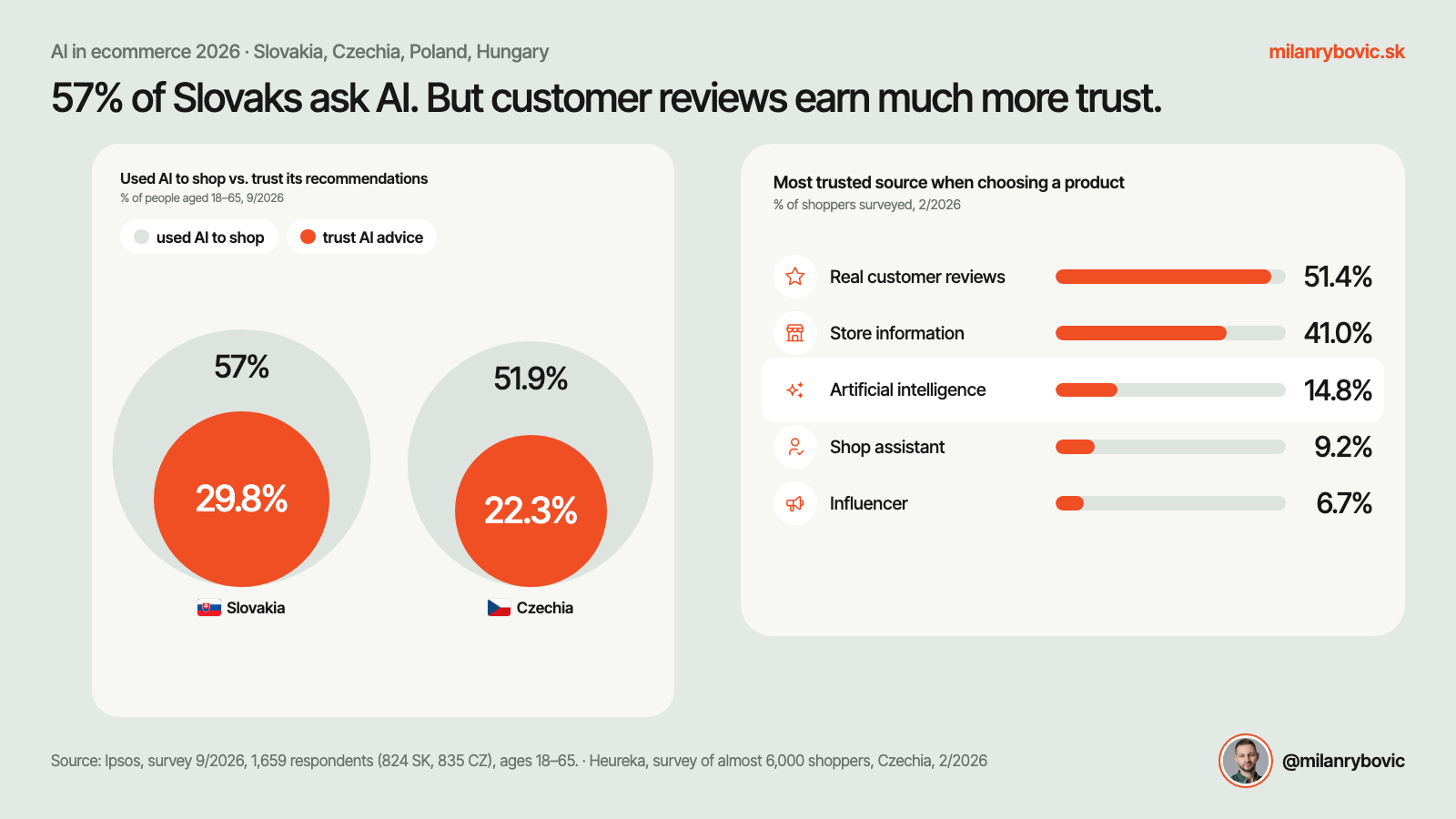
There’s a big gap between use and trust. While 57% of Slovaks ask AI for shopping advice, only 29.8% trust its recommendations. In Czechia, the figures are 51.9% versus 22.3%.
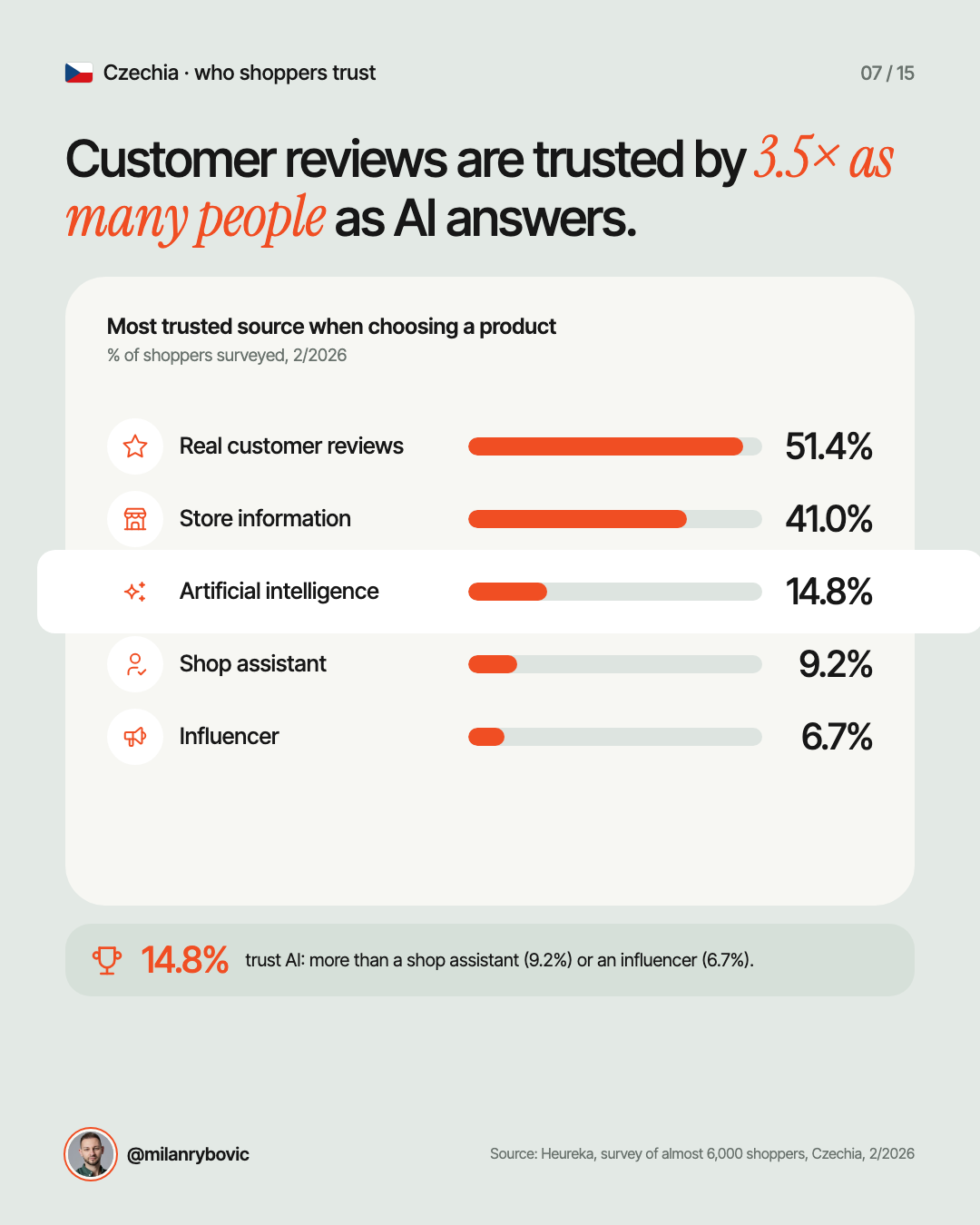
A Heureka survey of almost 6,000 customers shows who people trust most when choosing a product. Reviews from real customers (51.4%) come first, followed by information on the online store’s own website (41%). AI comes third at 14.8%. Yet it has already overtaken in-store salespeople (9.2%) and influencers (6.7%).
There’s an important takeaway here for online stores. AI is the customer’s first filter, but they make their decision on your website, based on reviews, product descriptions and availability information.
Will AI shop for us? Not yet
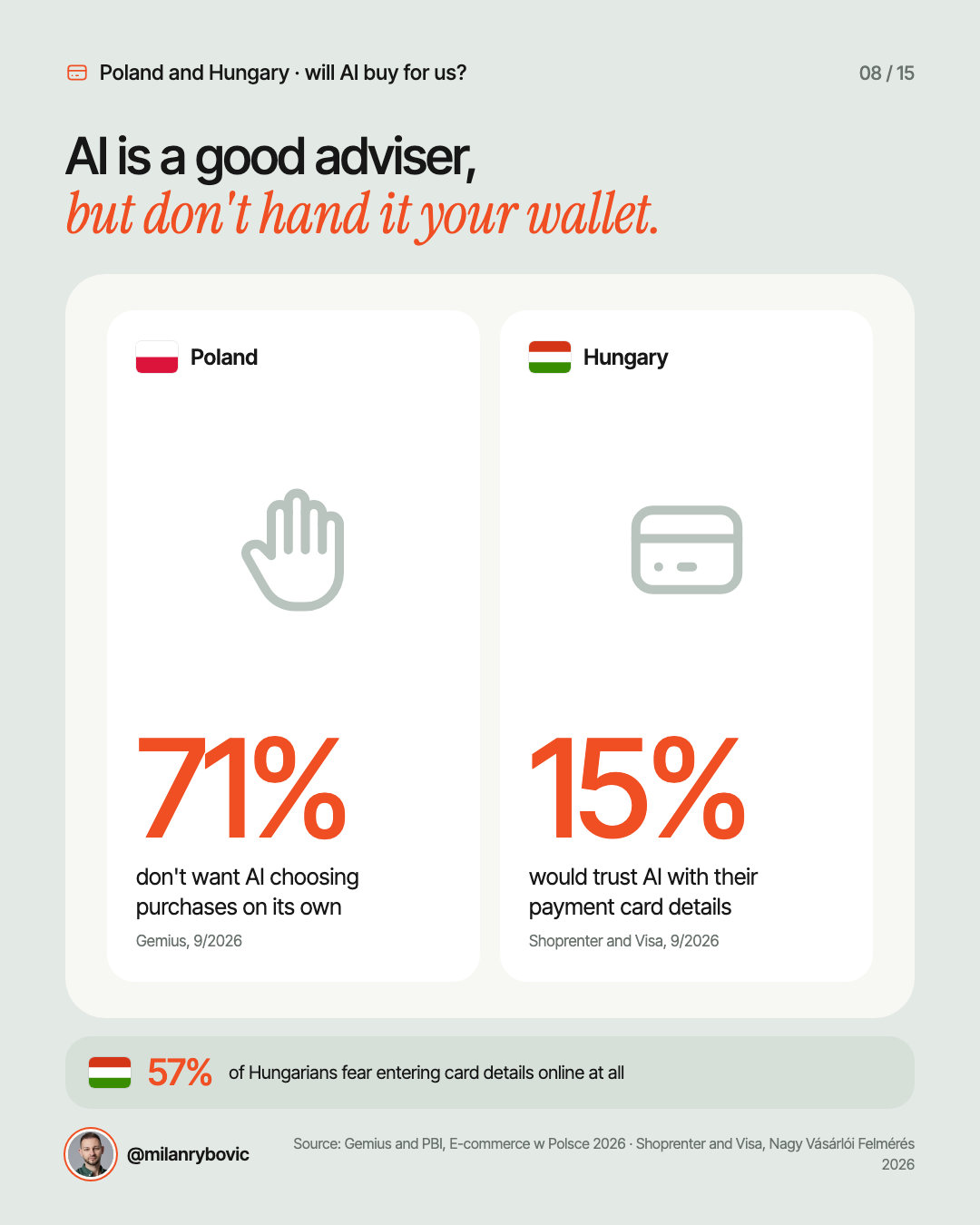
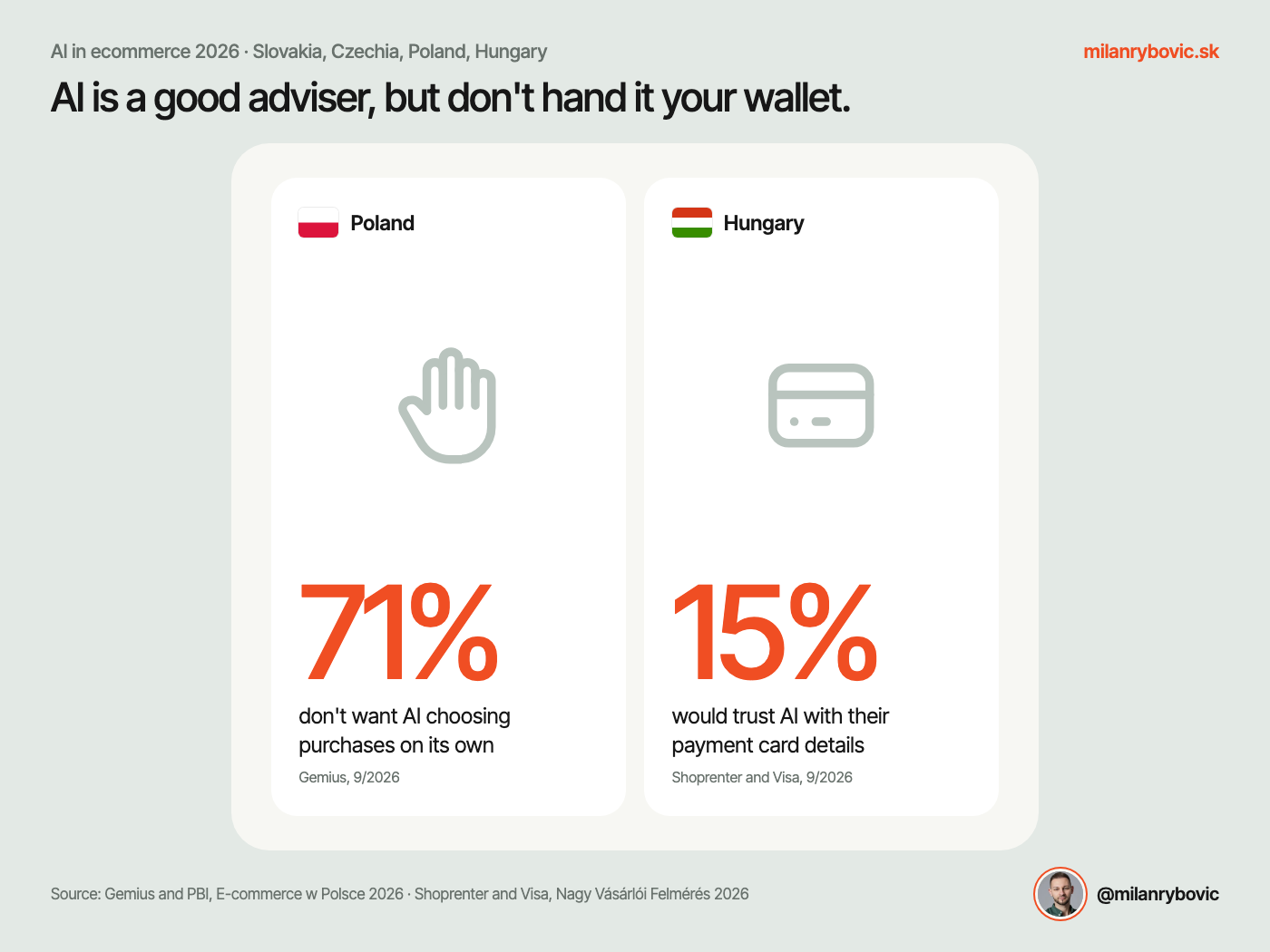
There’s a lot of talk about “AI agents” that will shop on people’s behalf. Data from the region shows that, for now, people still want to make the decisions themselves. In Poland, 71% of respondents don’t want AI to make purchasing decisions on its own, even though 65% of Poles use AI tools. In Hungary, only 15% of people would trust AI with their payment card details, and 57% are afraid to enter their card details online at all. Czech research by APEK also confirms that AI agents that shop independently haven’t caught on yet.
Who AI recommends: 9 out of 10 online stores are invisible to AI
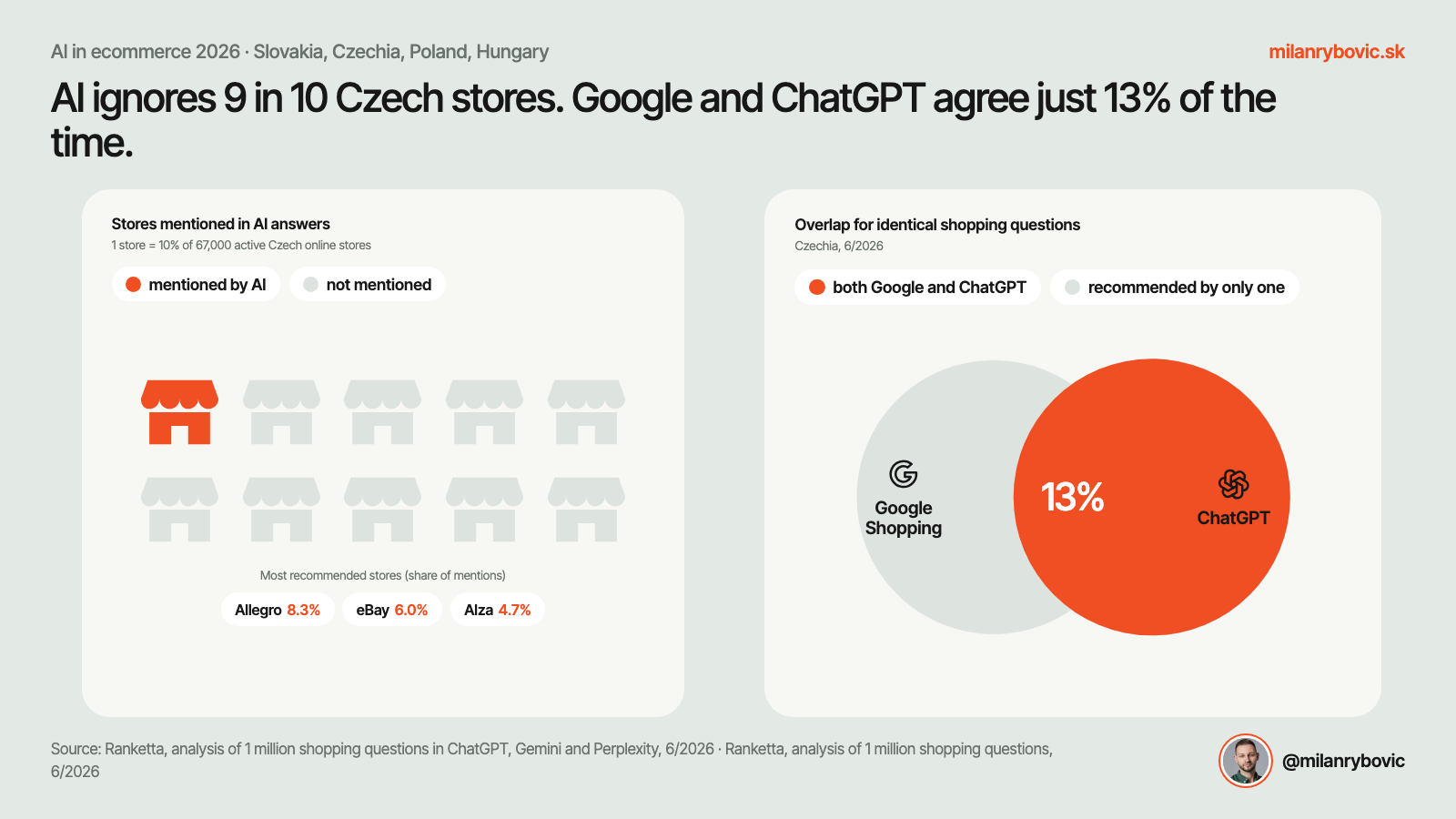
Startup Ranketta analyzed a million shopping questions in ChatGPT, Gemini and Perplexity. The result is uncomfortable for most online stores: AI mentions fewer than 10% of Czech online stores in its answers. It ignores the remaining roughly 91% of the 67,000 active stores. It most often recommends the big players: Allegro (8.3% of mentions), eBay (6%) and Alza (4.7%).
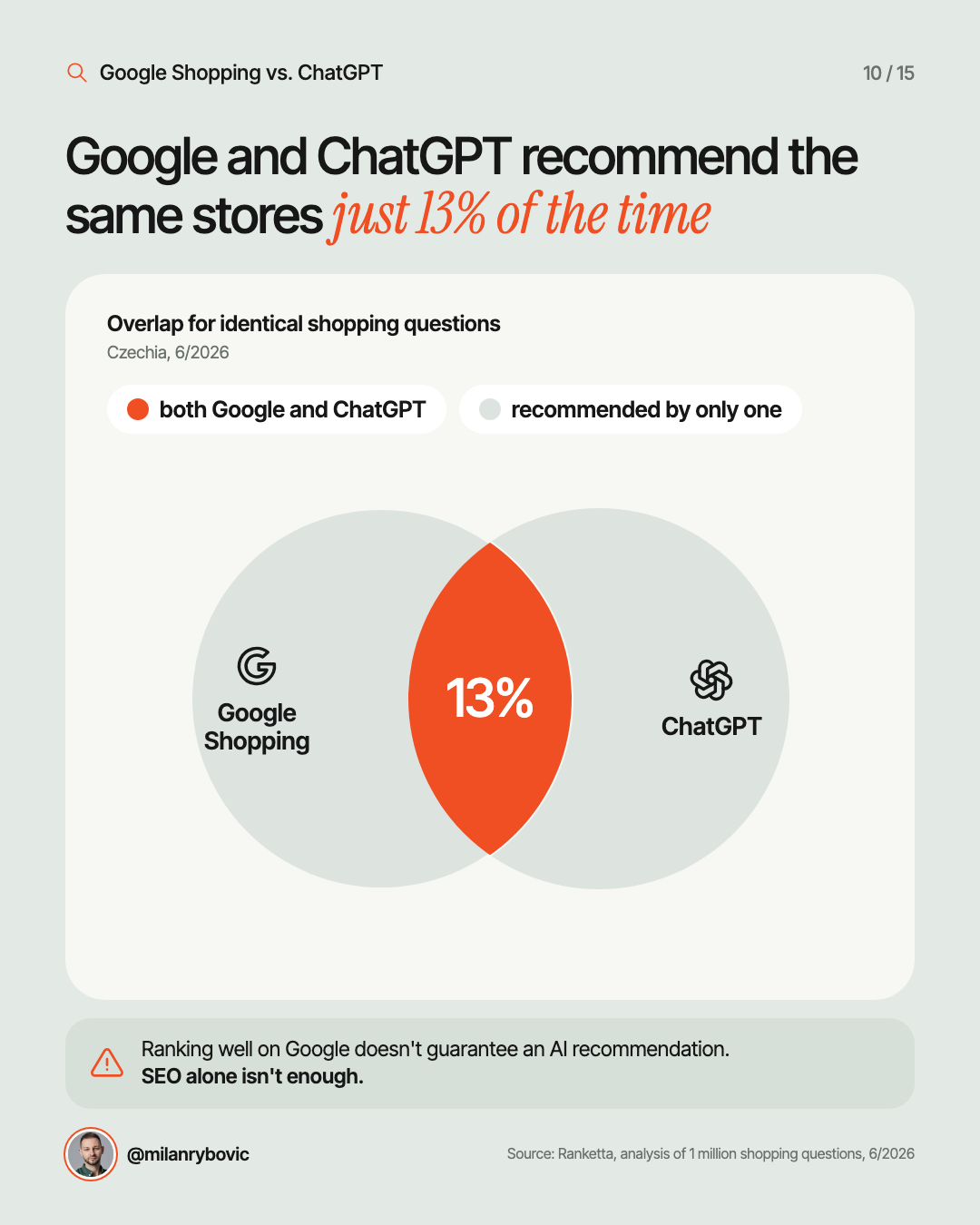
The second finding matters even more. For the same questions, Google Shopping and ChatGPT recommend the same stores in only 13% of cases. So ranking well on Google doesn’t necessarily mean AI will recommend you too. Traditional SEO isn’t enough.
How many orders AI actually brings online stores
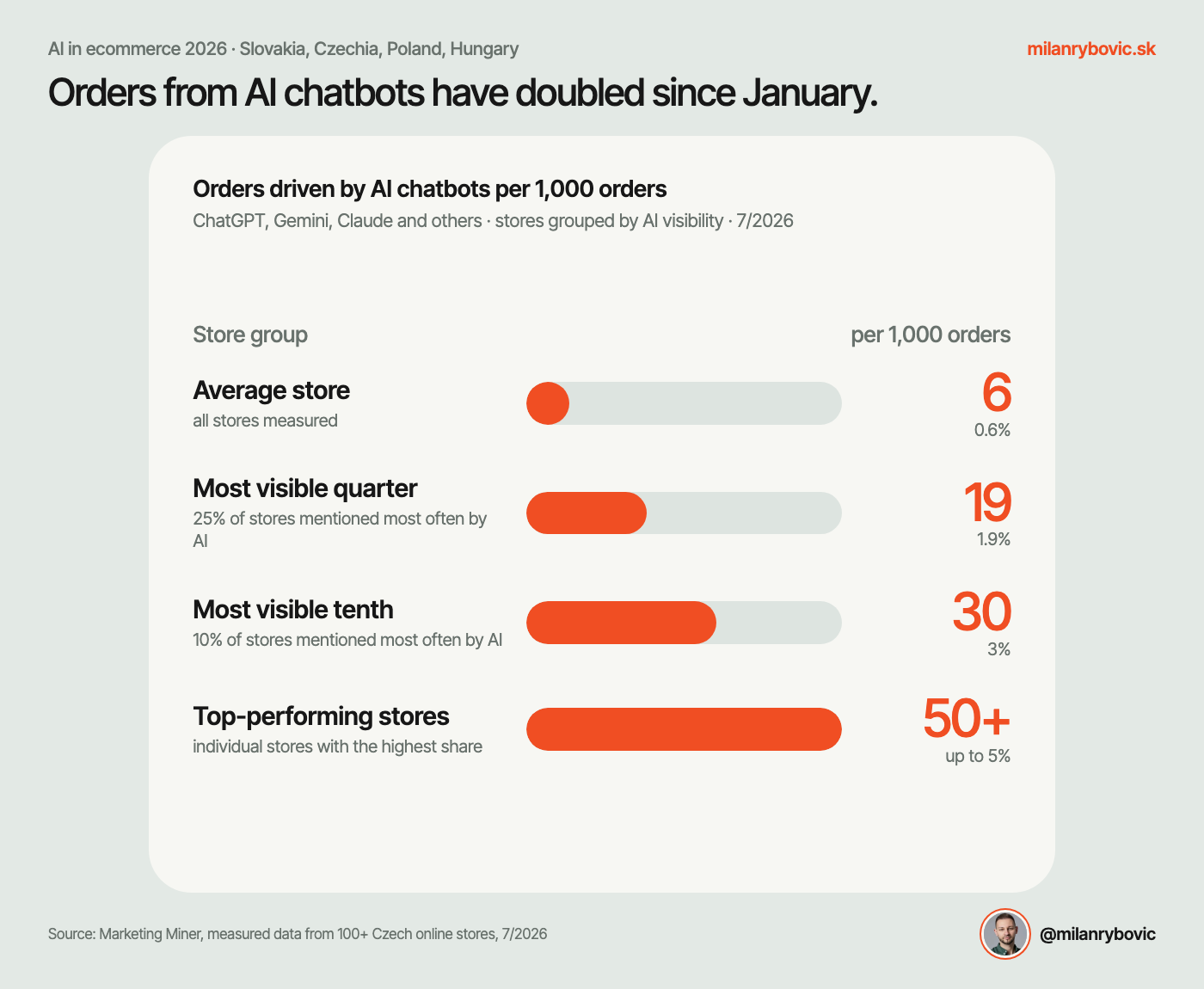
Marketing Miner measured data from a hundred Czech online stores. Orders generated by AI chatbots have doubled since January 2026. In absolute terms, the numbers are still small: the average online store gets 6 out of every 1,000 orders from AI. The most visible quarter of online stores gets 19, the most visible tenth gets 30, and individual stores get as many as 50 orders out of 1,000.
The most visible online stores therefore get five times as many orders from AI as the average. Today, 36% of businesses consider AI visibility critical, and 60% expect it to become critical within a year.
Businesses and online stores: almost everyone is trying AI, but few use it fully
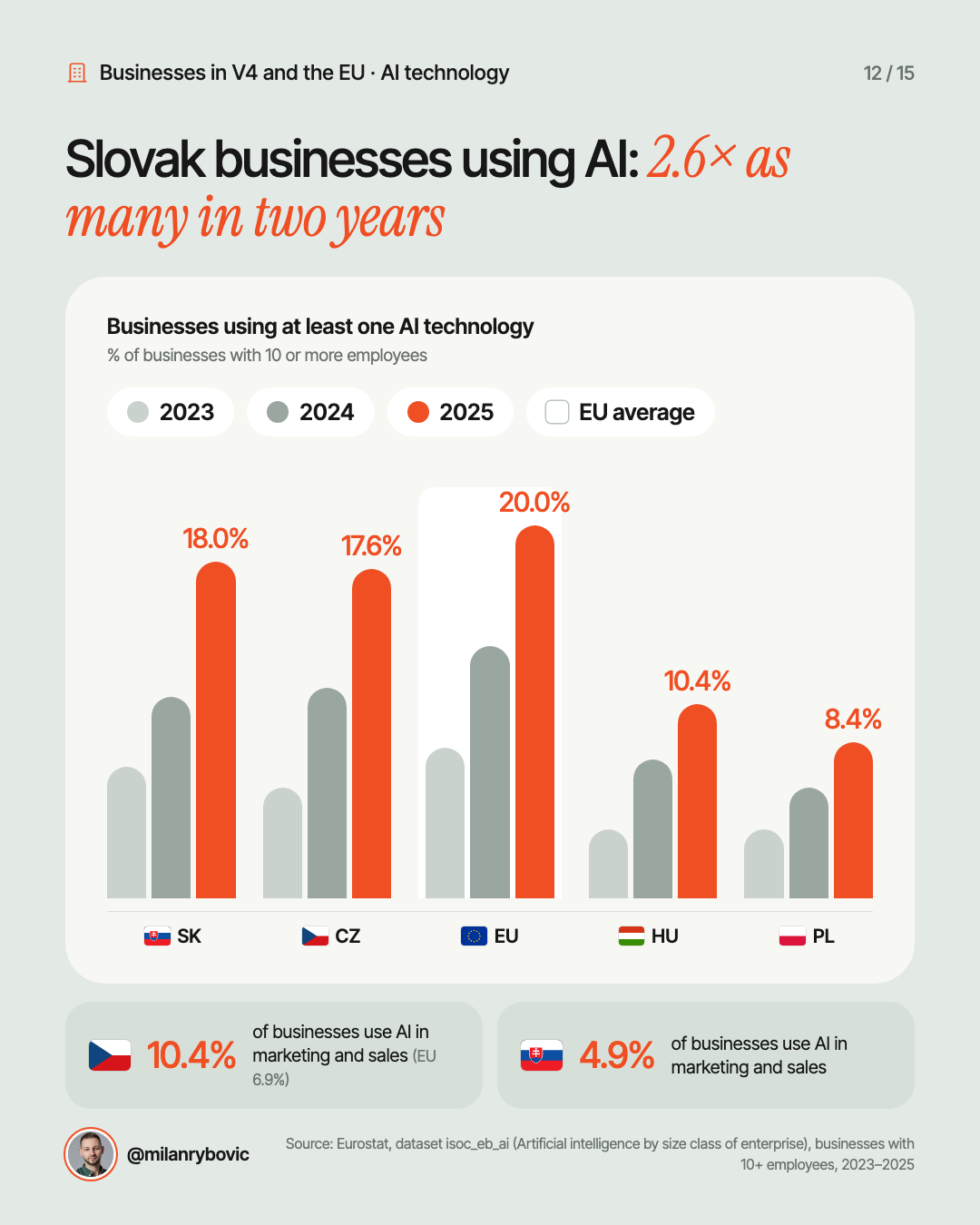
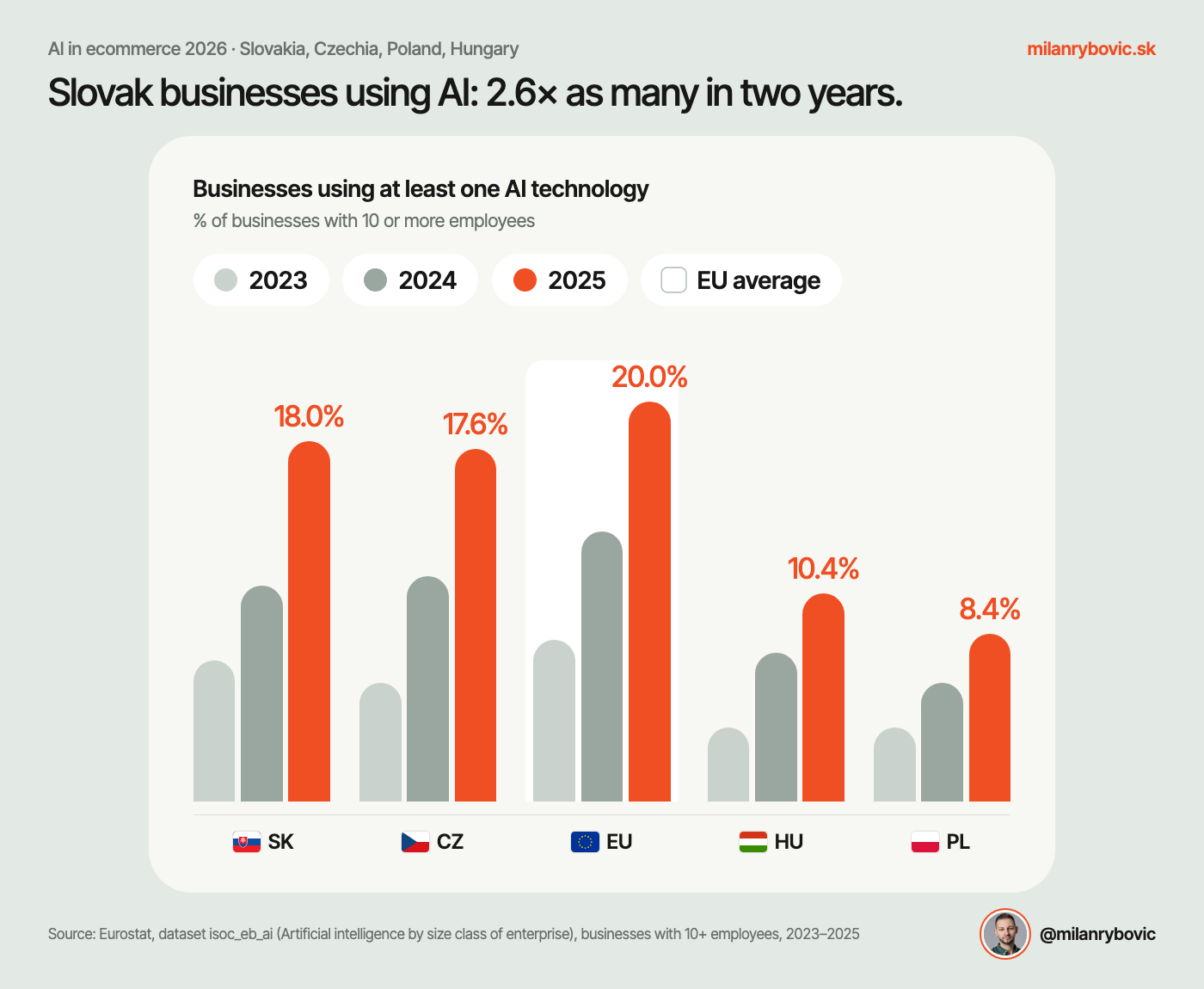
According to Eurostat, 18% of Slovak businesses with 10 or more employees use at least one AI technology. In 2023, the figure was 7%, so there are now 2.6 times as many as two years ago. Czechia is at 17.6%, Hungary at 10.4% and Poland at 8.4%. The EU average is 20%.
In marketing and sales, 10.4% of Czech businesses use AI, above the EU average of 6.9%. In Slovakia, the figure is 4.9%.
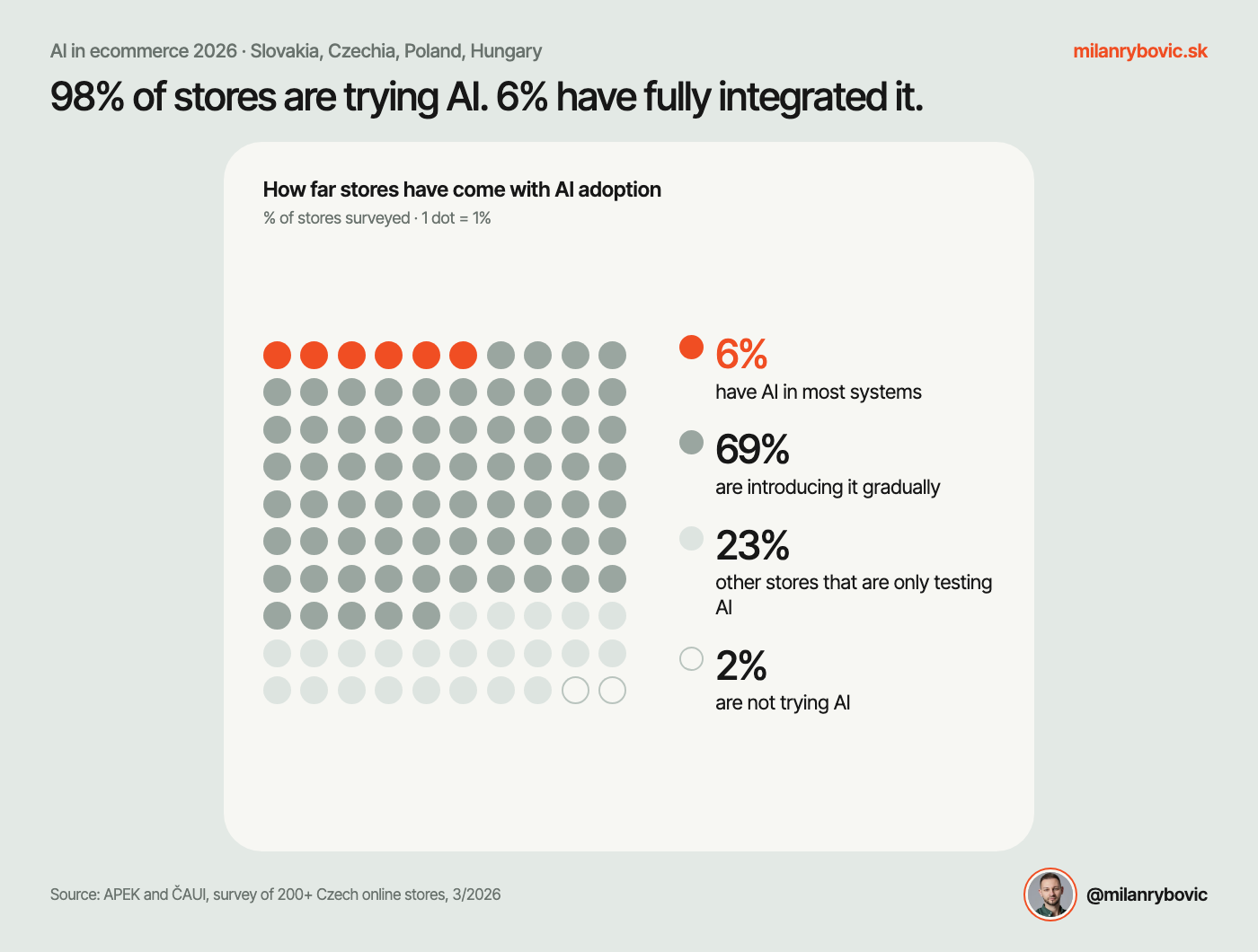
The picture is similar for online stores. According to a survey by APEK and ČAUI of more than 200 Czech online stores, 98% are trying AI in some form. While 69% are introducing it gradually, only 6% have integrated it into most of their systems. The main thing missing is a strategy, not technology.
Summary: AI in numbers across the V4
How to get AI to recommend your business too
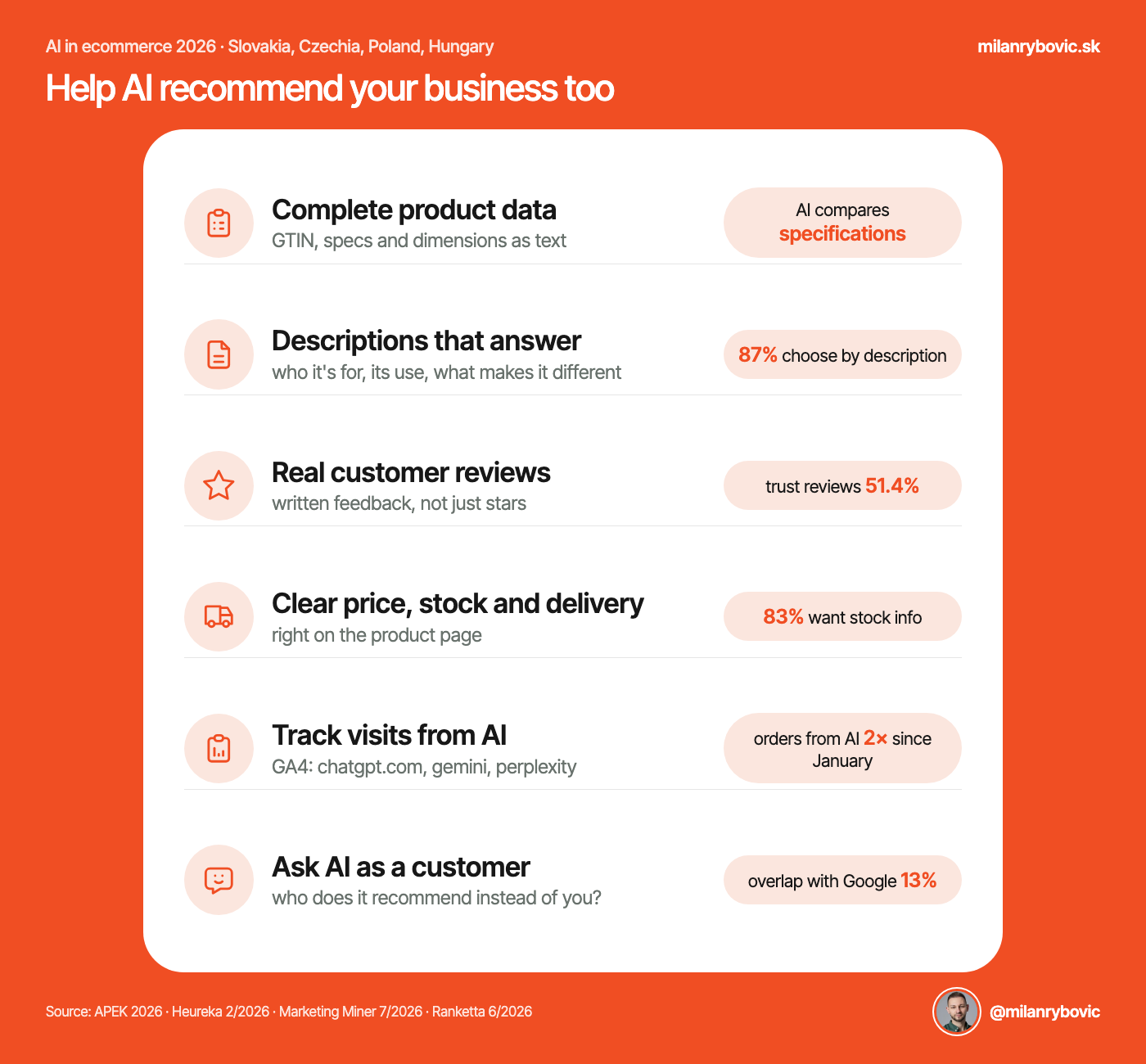
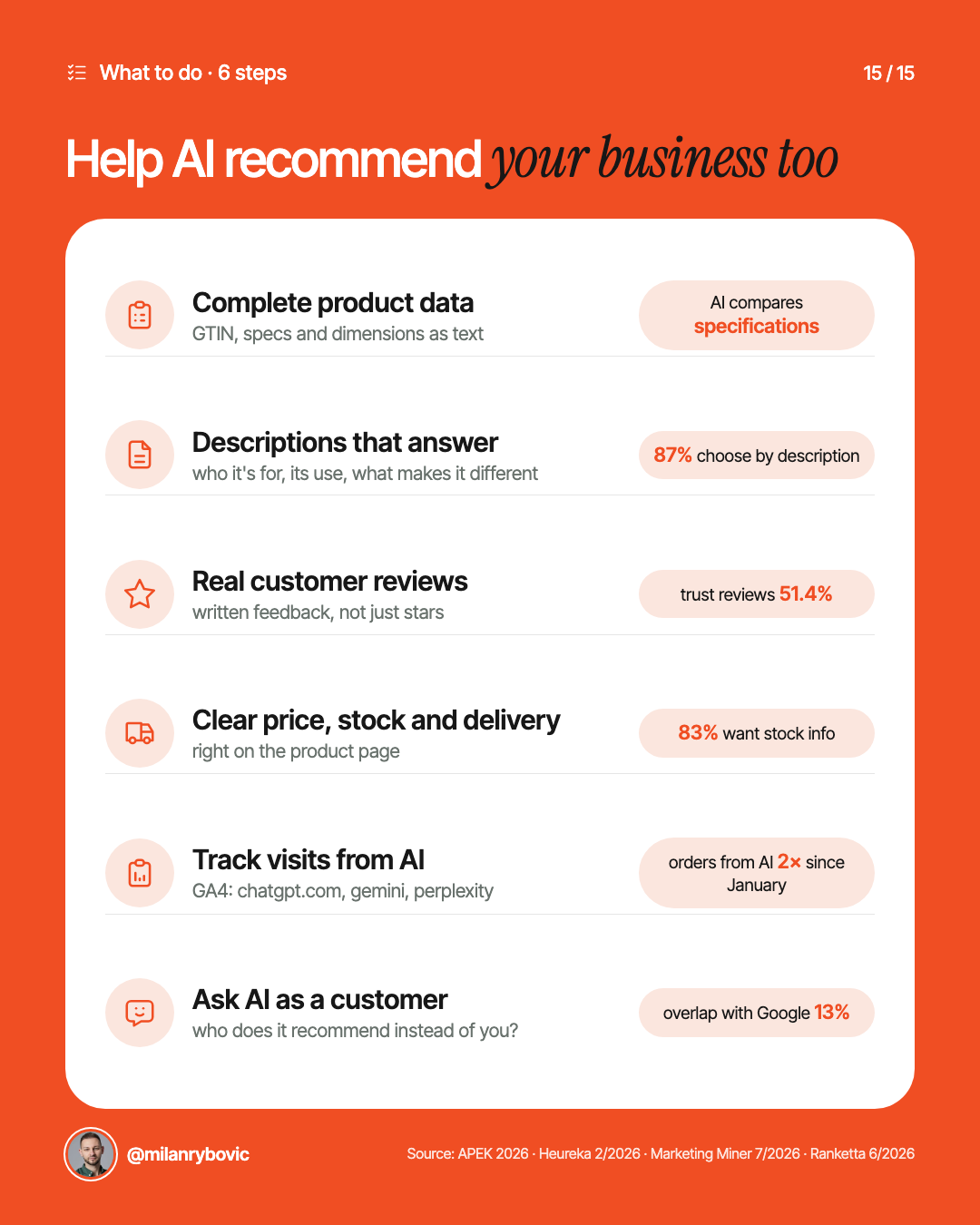
1. Complete product data. AI compares products by their specifications. Provide the GTIN (EAN), brand, model, dimensions, material and technical specifications as text, not just in an image or PDF. Include the same information in your product feeds.
2. Descriptions that answer questions. People ask AI questions in full sentences: who a product is for, what it’s good for and how it differs from the competition. If your description answers those questions, AI can use it. According to APEK, 87% of people cite detailed descriptions as a reason for choosing an online store.
3. Genuine customer reviews. 51.4% of shoppers trust reviews, and AI summarizes them when making recommendations. Collect verified reviews with written feedback, not just star ratings, and respond to them.
4. Clear pricing, stock and delivery information. AI includes these details in its answers. They should appear directly on the product page and in structured data (schema.org Product and Offer). When choosing an online store, 83% of people want clear information about availability and the option of parcel locker delivery.
5. Measure visits from AI. In Google Analytics 4, set up a segment for traffic from chatgpt.com, gemini.google.com, perplexity.ai and copilot.microsoft.com. Orders from AI have doubled since January, so make sure you know how many you’re getting.
6. Ask AI as a customer would. Enter the questions your customers ask into ChatGPT, Gemini and Perplexity, and see who they recommend instead of you. Since Google and ChatGPT agree in only 13% of cases, the result might surprise you.
Frequently asked questions
According to research agency Median, 2.7 million Slovaks aged 14 to 79 use AI tools (Q1 2026). There are 533,000 daily users.
Yes. In the past six months, 57% of Slovaks and 51.9% of Czechs aged 18 to 65 have used it to choose or buy a product (Ipsos, 9/2026).
For now, fewer people trust AI than use it. 29.8% of Slovaks and 22.3% of Czechs trust its recommendations. Reviews from real customers are trusted by 3.5 times as many people as AI.
The average Czech online store gets 6 orders out of 1,000 from AI chatbots, while the most visible stores get as many as 50. The number of these orders has doubled since January 2026 (Marketing Miner, 7/2026).
Start with complete product data, descriptions that answer customers’ questions, verified reviews and clear pricing, stock and delivery information. It also helps to regularly test who AI recommends when asked questions about your market segment.
Methodology and sources
- Eurostat, generative AI use by country and age (2025): https://ec.europa.eu/eurostat/databrowser/view/isoc_ai_iaiu/default/table
- Eurostat, businesses using AI technologies (2023–2025): https://ec.europa.eu/eurostat/databrowser/view/isoc_eb_ai/default/table
- Median SK, MML-TGI Q1 2026 (AI users in Slovakia): https://www.techbyte.sk/2026/06/slovaci-umelu-inteligenciu-kazdy-druhy-12-miliona-ludi/
- Ipsos, survey 9/2026, 1,659 respondents SK + CZ (published in E-commerce barometer 2026): https://www.ui42.sk/blog/e-commerce-barometer-2026-co-ukazali-data
- APEK, research on online shoppers 2026: https://www.apek.cz/clanky/pruzkum-apek-uvadi-trendy-na-pravou-miru-jak-cesi
- Heureka, survey of almost 6,000 customers (2/2026): https://retailnews.cz/aktualne/ai-pouziva-pri-nakupovani-temer-polovina-cechu-veri-ji-vic-nez-prodavacum-a-influencerum/
- Gemius and PBI, E-commerce w Polsce 2026: https://gemius.com/pl/news/raport-e-commerce-w-polsce-2026-jest-juz-dostepny/
- Shoprenter and Visa, Nagy Vásárlói Felmérés 2026: https://trademagazin.hu/hu/minden-hetedik-magyar-mar-megadna-a-bankkartyaadatait-az-ai-nak/
- Ranketta, analysis of 1 million shopping questions asked of AI (6/2026): https://www.lupa.cz/clanky/umela-inteligence-si-pri-doporucovvani-uzivatelum-vybira-sve-favority-devet-z-deseti-ceskych-e-shopu-pro-ni-neexistuje/
- Marketing Miner, orders from AI chatbots, 100+ Czech online stores (7/2026): https://www.lupa.cz/clanky/pocet-objednavek-ktere-privedla-ai-se-v-ceskych-e-shopech-od-ledna-zdvojnasobil-viditelnost-v-chatbotech-ma-byt-zasadni/
- APEK and ČAUI, survey of 200+ Czech online stores (3/2026): https://www.apek.cz/clanky/ceska-e-commerce-uprostred-ai-revoluce-firmy-masi
The surveys differ in their methodology, respondents’ ages and the periods they cover. That’s why I don’t mix figures from different sources in the charts, and I state where each figure comes from.
Milan Rybovič, AI × Marketing × E-commerce. I share data and solutions that work. Follow me on Instagram @milanrybovic.